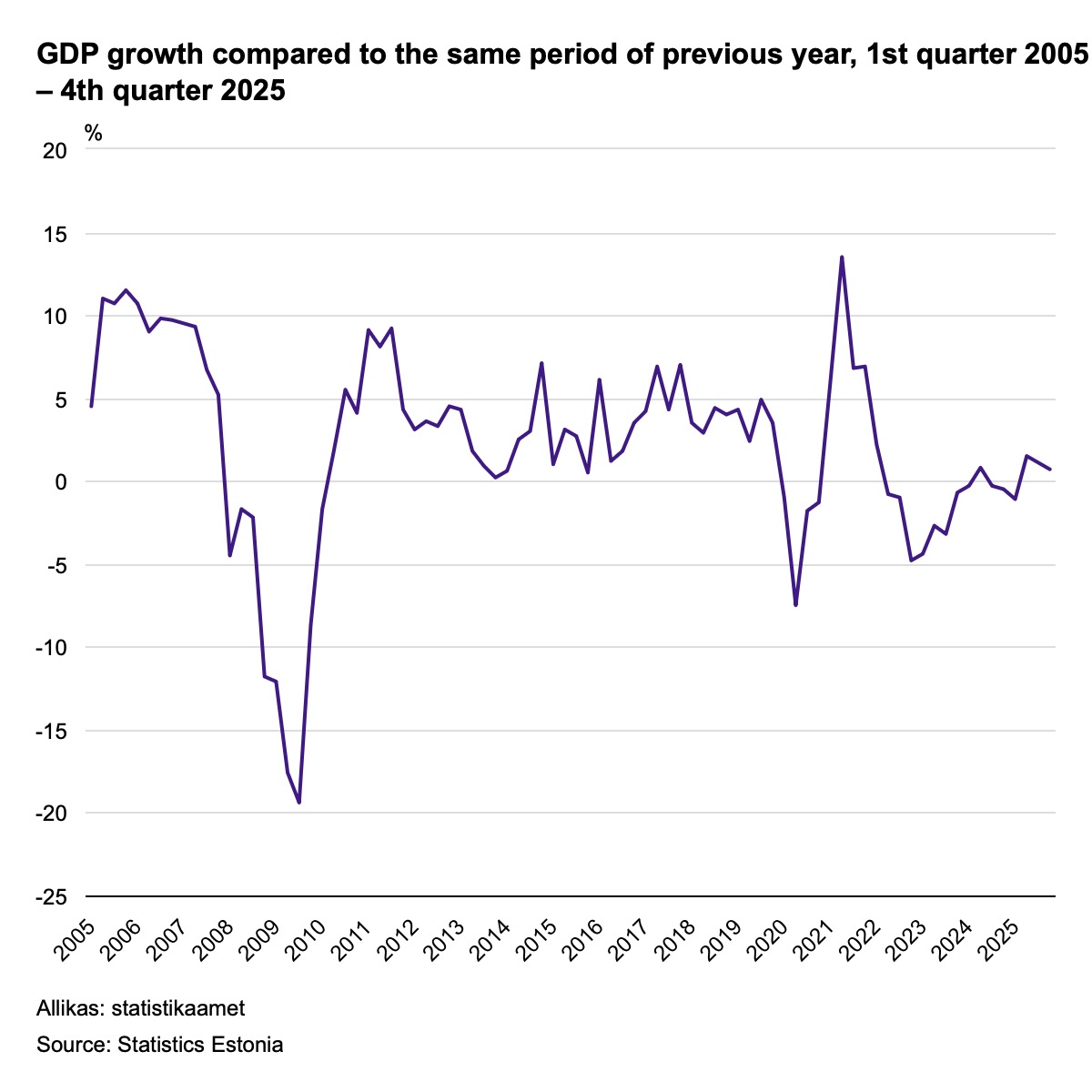
Estonia’s economy returned to growth in 2025, with gross domestic product rising by 0.7 per cent in the fourth quarter compared with the same period a year earlier; across the year as a whole, GDP grew by 0.6 per cent, marking an improvement on the previous two years.
At current prices, GDP totalled €11 billion in the final quarter of 2025 and €41.6 billion over the year as a whole.
Robert Müürsepp, manager of the national accounts service at Statistics Estonia, the official statistics agency, said 2025 had been a stronger year for the economy than the two preceding ones.
“GDP grew in the final three quarters of the year, and annual growth reached 0.6 per cent,” he said.
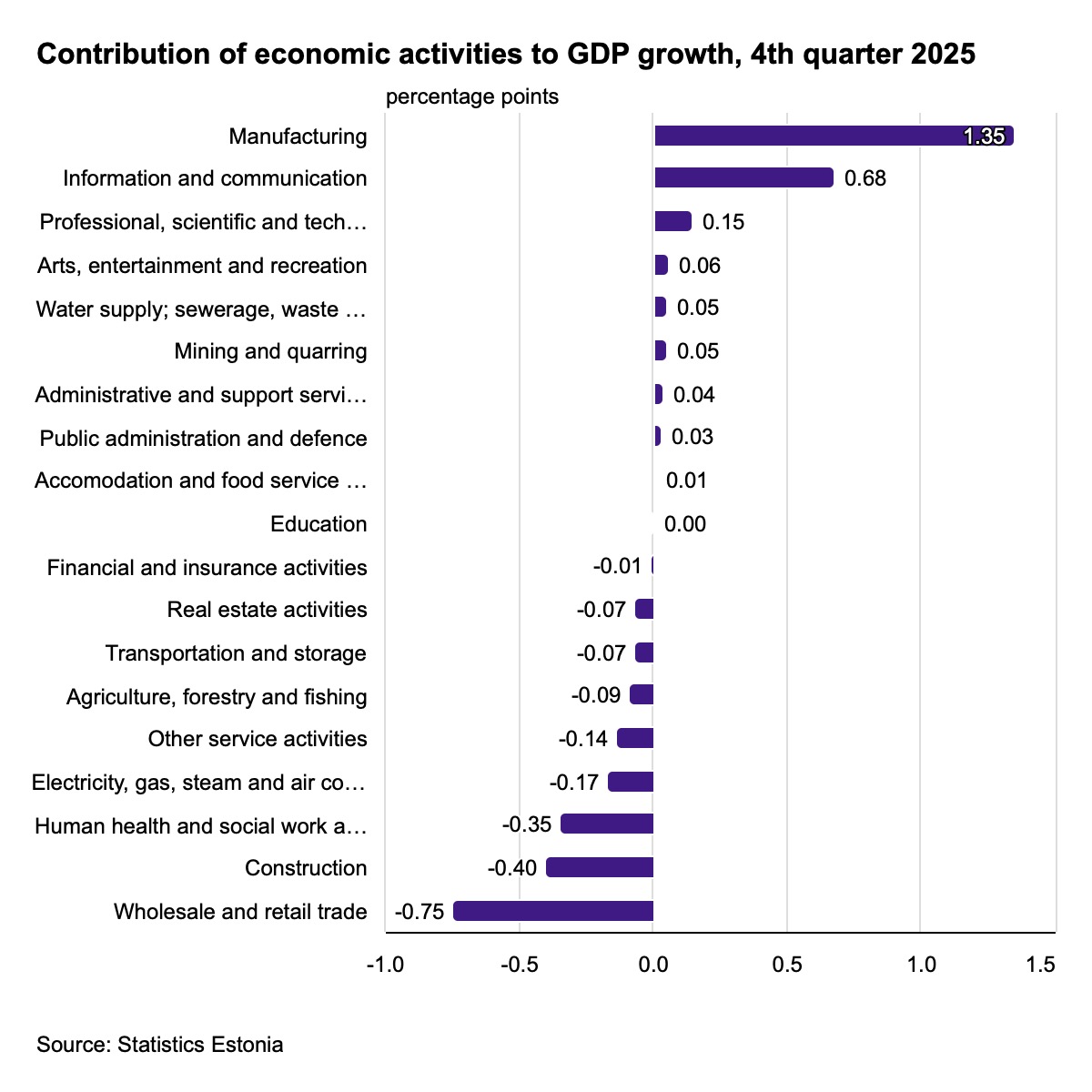
As in the third quarter, however, the contribution of most sectors remained modest. Manufacturing was the strongest positive driver, with value added rising by 13.3 per cent. Information and communication also made a notable contribution, rebounding from its mid-year slump to post growth of 9 per cent.
The trade sector remained a drag on the economy for the third consecutive quarter, with value added falling by 7.6 per cent. Other sectors weighing significantly on GDP included construction, down 7.6 per cent, and human health and social work activities, which declined by 7.1 per cent.
Consumers cut spending on alcohol and transport
Private consumption fell by 0.4 per cent in the fourth quarter, owing chiefly to lower spending on transport, as well as on alcohol and tobacco. Household spending increased, however, on financial and insurance services, recreation and furnishings. There was also a slight rise in expenditure on clothing and footwear, and on information and communication.
Investment rose 6.9 per cent in the fourth quarter, its strongest showing of the year, driven by a 42.8 per cent surge in non-financial corporations’ spending on buildings and infrastructure and a 22.8 per cent increase in household investment in housing. Offsetting some of that momentum were a 42 per cent slump in corporate spending on machinery and equipment and a 12.7 per cent fall in general government investment in buildings and infrastructure.
Foreign trade continued to expand in the fourth quarter, with exports rising by 4.7 per cent and imports by 3.1 per cent. “Net exports stood at €183.2 million – the strongest result since the first quarter of 2023,” Müürsepp said.
In the goods sector, exports increased by 4.1 per cent and imports by 2.3 per cent. Trade in coke and refined petroleum products, non-monetary gold, fabricated metal products, computers and electronic products, and electrical equipment rose markedly. By contrast, motor vehicle imports had the largest negative effect on goods trade.

In services, exports grew by 5.6 per cent and imports by 4.8 per cent, driven chiefly by the sale and purchase of advertising, polling and other business services.
On a seasonally and working-day adjusted basis, GDP fell by 0.1 per cent compared with the third quarter of 2025, but was 0.8 per cent higher than in the fourth quarter of 2024.
For 2025 as a whole, value added rose by 0.3 per cent. Over the year, value added fell by 0.2 per cent in the non-financial corporations sector and by 0.4 per cent in the financial sector. By contrast, the general government sector recorded growth of 2.3 per cent. For the first time in three years, value added in the non-profit institutions sector also declined, falling by 0.4 per cent in 2025.
More spending goes on recreation and insurance
The chief drivers of growth in 2025 were manufacturing and information and communication.
Among the larger sectors, real estate activities also gave the economy a notable lift. The main drags on growth, by contrast, were trade, transportation and storage, and construction.
Private consumption remained at the same level as in 2023, having also stagnated the previous year. Looking at household spending, the sharpest increase in 2025 came in financial and insurance services. There was also a marked rise in expenditure on furnishings, recreation, information and communication, and education. The steepest falls were in spending on transport, alcohol and tobacco, and restaurants and accommodation services.
Over 2025 as a whole, net taxes on products rose by 2.9 per cent, while investment increased by 3.2 per cent. Investment growth was driven by the government sector, where investment was up by 11.1 per cent. The strongest rise was in investment in other machinery and equipment and weapons systems, which surged by 73.2 per cent.
Both exports and imports grew by 5 per cent last year. By the end of 2025, net exports had reached €401.6 million, giving Estonia its largest trade surplus since 2019.