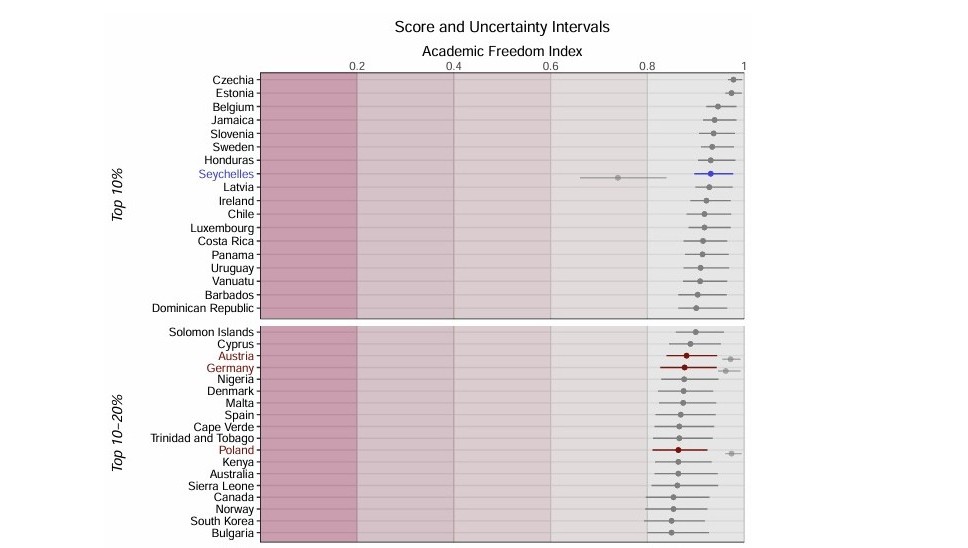
Estonia ranks second in the world for academic freedom, according to the latest Academic Freedom Index, at a time when standards are declining globally.
The result puts Estonia in the global top tier at a time when academic freedom is moving in the opposite direction across much of the world. The report finds that over the past ten years, academic freedom has declined in 50 countries, while only nine have improved.
The index measures five areas: freedom to research and teach, freedom of academic exchange, freedom of academic and cultural expression, institutional autonomy, and campus integrity.
The broad trend is negative across all five. The sharpest declines between 2015 and 2025 were recorded in freedom to research and teach and campus integrity, each worsening significantly in 51 countries. Freedom of academic exchange declined in 47 countries, academic and cultural expression in 46, and institutional autonomy in 43.
That makes Estonia’s position notable not only regionally, but globally.
The Czech Republic and Estonia lead the pack
The chart accompanying the report places Estonia immediately below the Czech Republic and above Belgium in the highest-performing group. In practical terms, that means Estonia is judged to offer some of the strongest protections in the world for independent research, teaching and academic expression.
The countries with the least academic freedom are Nicaragua, Myanmar and Eritrea.
The report argues that institutional autonomy is central to that protection. Universities that can govern themselves without undue political or ideological interference are more likely to protect the freedom of individual academics. The data show a very strong positive correlation between institutional autonomy and freedom to research and teach.
This matters because the report identifies a troubling trend not only in authoritarian states, but also in democracies.
A benchmark worth defending
One of its strongest findings concerns the United States, where institutional autonomy has dropped sharply since 2020 and deteriorated further in 2025. The authors describe the American decline as unusually fast and steep, comparing it with longer-term erosion in countries such as Hungary, India and Turkey.
The report says political interference in university governance, hiring, curricula and research priorities has become a growing feature of American higher education. It also points to pressure linked to accreditation, federal funding and executive action.

The report’s wider message is cautionary. Academic freedom is proving easier to erode than to restore. Even where formal protections exist, governments and other outside actors can weaken universities through funding pressure, governance changes and political intervention.
That is why Estonia’s second-place ranking should be read not simply as good news, but as a benchmark worth defending.
The Academic Freedom Index was launched in 2020 by researchers at Friedrich-Alexander-Universität Erlangen-Nürnberg, the V-Dem Institute, the Scholars at Risk Network and the Global Public Policy Institute. The project began with an expert consultation in Cologne in 2017.