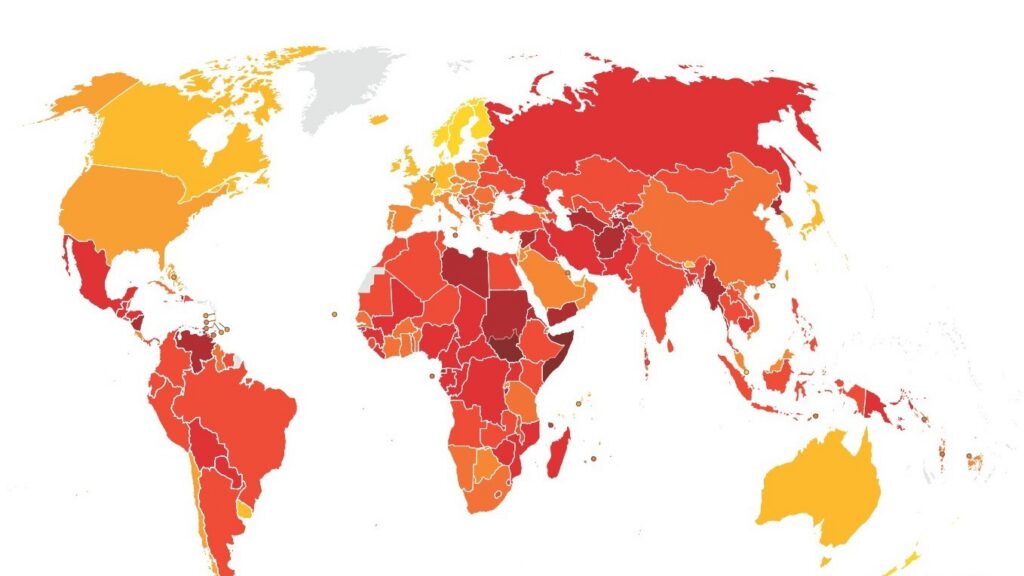
According to Transparency International’s Corruption Perceptions Index 2025, Estonia is among the least corrupt countries in the world – ranking ahead of long-established democracies such as the United Kingdom and the United States.
The 2025 index, which measures perceived levels of public sector corruption in 182 countries and territories worldwide, places Estonia joint eighth among the least corrupt nations. It shares this position with Australia, Hong Kong and Ireland.
Each country is assigned a score from 0 to 100, where 100 signifies “very clean” and 0 indicates “highly corrupt”. Estonia’s score in the 2025 index is 76.
Transparency International does not provide specific commentary on Estonia’s performance beyond noting that “persistent consolidation of anti-corruption efforts has driven progress in countries like Estonia (76), South Korea (63), Bhutan (71) and Seychelles (68).”
The least corrupt country in the world is Denmark, with a score of 89, followed by Finland (88), Singapore (84), and New Zealand and Norway (both 81).

A worsening corruption trend in democracies
Lithuania scored 65 in the 2025 index and Latvia 60.
The United Kingdom received a score of 70, while the United States scored just 64 – placing both countries below Estonia and indicating higher perceived levels of corruption.
The 2025 Corruption Perceptions Index assesses perceived levels of public-sector corruption in 182 countries and territories, drawing on 13 independent data sources. This year, the global CPI average has fallen for the first time in more than a decade, dropping to just 42 out of 100.
The vast majority of countries are struggling to keep corruption under control: 122 out of 182 score below 50 in the index. At the same time, the number of countries scoring above 80 has declined sharply – from 12 a decade ago to just five this year.
“In particular, there is a worrying trend of democracies seeing worsening perceived corruption – from the United States (64), Canada (75) and New Zealand (81), to various parts of Europe, including the United Kingdom (70), France (66) and Sweden (80),” Transparency International notes.
The organisation is urging governments and leaders worldwide to strengthen justice systems, ensure independent oversight of decision-making and public spending, guarantee transparency in the funding of political parties and election campaigns, and safeguard civic space, democracy and media freedom.
Do-nothing governments may get toppled by the people
“At the same time, they should collaborate to tackle shared challenges – for example, closing the cross-border channels that enable transnational corruption, such as laundering and hiding stolen funds.”
“As we saw this year, governments who fail to address their citizens’ concerns may find themselves toppled by popular protest movements. What’s more, businesses may look elsewhere to invest, costing countries economic opportunities and jobs. By choosing to act for the public interest, not private gain, governments and leaders can live up to their responsibilities to shape and nurture safe, fair and healthy societies where everyone can thrive.”
Since its inception in 1995, the Corruption Perceptions Index has become one of the leading global indicators of public sector corruption. The index scores 182 countries and territories around the world based on perceptions of public sector corruption, using data from 13 external sources, including the World Bank, the World Economic Forum, private risk and consulting companies, think tanks and others.
Transparency International is a German non-governmental organisation founded in 1993. Based in Berlin, its nonprofit purpose is to take action to combat global corruption with civil societal anti-corruption measures and to prevent criminal activities arising from corruption.