Estonia remains among the world’s top 10 education systems, according to the OECD’s latest PISA results; its 15-year-olds outperformed the OECD average in science, maths and reading, but the country’s reading score has fallen to its lowest level since Estonia first took part in the assessment.
More than 760,000 students in 91 countries and economies took part in PISA 2025, which measures how well 15-year-olds can apply their knowledge to unfamiliar problems.
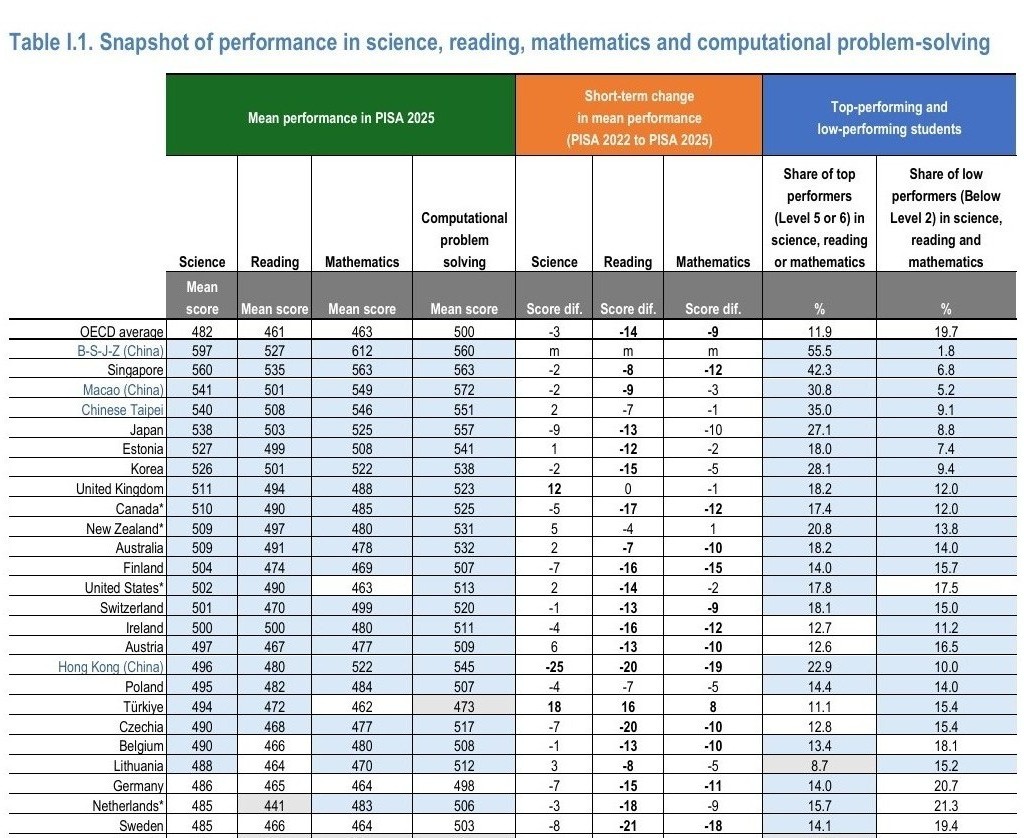
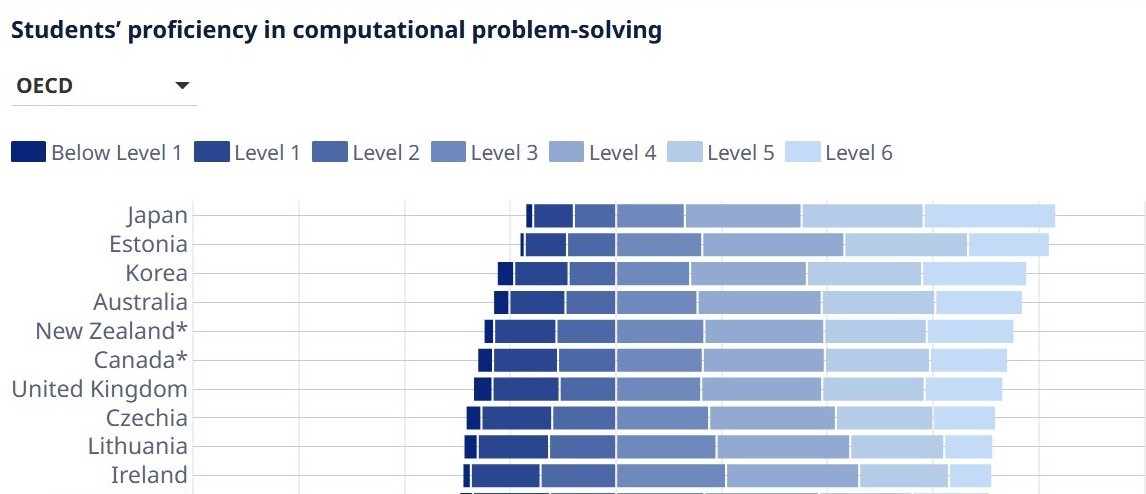
Estonian students scored 527 points in science, 508 in mathematics and 499 in reading. A new assessment of computational problem-solving produced a score of 541. When non-OECD participants and the Chinese jurisdictions are included, Estonia ranked sixth in science, eighth in mathematics and reading, and seventh in computational problem-solving.
Among OECD countries, Estonia was outperformed overall only by Japan and South Korea.
“It is undoubtedly a day for celebration, because we are in a very good place compared with others,” Gunda Tire, the head of international studies at Estonia’s Education and Youth Board, told Estonian Public Broadcasting’s science portal Novaator. “But it also sets off an alarm bell.”
Estonia’s best PISA results were recorded in 2018. The latest figures show that the country has managed to preserve much of its advantage while education systems across the OECD have suffered their steepest decline on record.
The reading problem
The most troubling result concerns reading. Estonia’s score of 499 was 24 points lower than in 2018 and below the country’s result in every previous PISA assessment. The decline is also significant compared with 2022.
PISA’s rough rule of thumb is that a fall of 20 to 25 points represents about a year of learning. By that measure, the latest cohort of Estonian teenagers is reading at a level roughly a year behind that of students tested less than a decade ago.
The decline is not unique to Estonia. Across the OECD, reading scores fell by 28 points between 2015 and 2025. The OECD said the sharpest losses were in skills that matter in the age of artificial intelligence – evaluating information, connecting material from different sources and thinking critically about what is being read.
The proportion of students displaying “hasty reading”, in which they read quickly but inaccurately, almost doubled between 2018 and 2025, reaching 9%.
Estonia still performed well by international standards. Some 83% of students reached at least Level 2 proficiency in reading, compared with 69% across the OECD, while 9% were top performers, compared with 6% internationally.
But the direction of travel has alarmed teachers.
“In PISA, students have to read, connect, draw conclusions and evaluate,” Kaja Sarapuu, chair of the Estonian Association of Mother Tongue Teachers, said. “At school, we mostly just read and find a fact in a text.”
Sarapuu said students were reading fewer long-form texts and were increasingly accustomed to moving rapidly between short fragments of information. Schools, she argued, needed to give pupils more opportunities to puzzle over a text, draw their own conclusions and defend an interpretation.

Digital technology is part of the picture, although the results do not support a simple story in which screens automatically damage learning. Estonian students reported spending an average of 1.5 hours a day using digital devices for learning at school and 1.3 hours using them for leisure. Some 36% said their classmates were often distracted by digital devices during most or every science lesson, compared with 28% across the OECD.
Yet Estonia was among the countries where digital distraction was not significantly associated with lower science performance.
The country’s students also performed strongly in the new computational problem-solving assessment, which tested their ability to use modelling and programming tools, conduct experiments and design digital products. Estonia’s score of 541 placed it near the top of the international table.
The paradox is becoming sharper with the rapid spread of generative AI. Some 58% of Estonian students said they used AI chatbots to help them learn at least once a week, compared with 46% across the OECD. Only 7% said they never or almost never used AI chatbots for any of the schoolwork tasks examined by PISA.
The OECD cautioned that students who used AI for specific tasks such as summarising texts, drafting assignments or conducting research scored about 20 points lower in science than those who did not. The finding shows an association rather than proving that AI caused the weaker performance, but it suggests that the technology is no substitute for understanding.
Strong results, growing gaps
Estonia’s science results remain particularly impressive. Its score of 527 was one point higher than in 2022 and broadly stable over the longer term. Only Japan scored higher among OECD countries.
Nine out of 10 Estonian students reached the baseline level of science proficiency, compared with 74% across the OECD. Some 11% were top performers, compared with 7% internationally.
Estonian pupils are especially strong at designing and evaluating scientific investigations, rather than simply recalling information or explaining familiar phenomena.
Mathematics produced a score of 508, two points lower than in 2022. Tiina Kraavi, a lecturer in maths education at the University of Tartu, said the change was small enough to fall within normal fluctuation. But she warned against treating the result as evidence that everything was fine.
The proportion of low-performing students has risen by six percentage points in both mathematics and reading since 2015. The gap between the highest- and lowest-performing students also widened in mathematics between 2022 and 2025.
There is a persistent gender divide. Boys outperformed girls in mathematics by 13 points, while girls were 25 points ahead of boys in reading. In Finland, the mathematics gap was just two points.
“We talk a great deal about mathematics and the need for more engineers,” Kraavi said. “But engineering is not a field for boys alone.”
Socio-economic inequality is less pronounced in Estonia than in many other OECD countries. Advantaged students outperformed disadvantaged students by 68 points in science, compared with an OECD average gap of 85 points. Socio-economic background accounted for 10% of the variation in science performance in Estonia, compared with 12% across the OECD.
Even so, Triin Lauri, professor of comparative public policy at Tallinn University, said the national figures might conceal a growing divide between schools. Families increasingly avoid their local school, she said, and differences in parents’ incomes between schools have become substantial.
The sharpest gap is linguistic. Students from Russian-language backgrounds scored 47 points lower in science than students whose home language was Estonian – a difference equivalent to more than two years of learning by the usual PISA comparison.
Estonia’s transition to Estonian-language education began in the first and fourth grades in 2024. Experts say the full effect of the reform will not become visible for several years, with some of its results unlikely to appear in PISA data before about 2031.
“The state did not do enough to prepare teachers who could help children learn Estonian while maintaining educational quality,” Lauri said. “The reform was necessary, but it came after years in which the gap was allowed to grow.”
A system under pressure
The latest PISA results also reveal the strain inside Estonia’s schools.
Some 65% of students attended schools whose principals said that teaching was hindered by a shortage of teaching staff, compared with 39% across the OECD. The figure was an improvement on 2022, when it stood at 73%, but remains one of the highest among developed education systems.
A further 39% of students were in schools where a lack of educational materials was seen as an obstacle to teaching. The same proportion attended schools where physical infrastructure was considered a problem.
Bullying is another concern. In 2025, 27% of Estonian students said they had experienced at least one form of bullying several times a month or more, compared with 20% across the OECD.
The picture is not uniformly bleak. Estonian students reported slightly higher curiosity than the OECD average, and 83% said they believed intelligence could be developed through effort, work and feedback. That compares with 69% across the OECD.
Students with this so-called growth mindset scored 36 points higher in science than those with a fixed mindset, after socio-economic factors were taken into account. Some 21% of Estonian students said school was a waste of time, below the OECD average of 24%.
But only 43% said they often or very often planned their approach to studying. Estonia’s students may believe they can improve, in other words, without always having been taught how to organise the work required to do so.
Estonia’s PISA story is one of continued strength under pressure: its students remain among the world’s strongest performers in science, mathematics and computational problem-solving, and the system remains comparatively equitable.
But teacher shortages, falling reading scores and the transition to Estonian-language education are testing it. The next challenge is to sustain the patient work that teaches young people to read carefully, question answers and understand the world around them.