
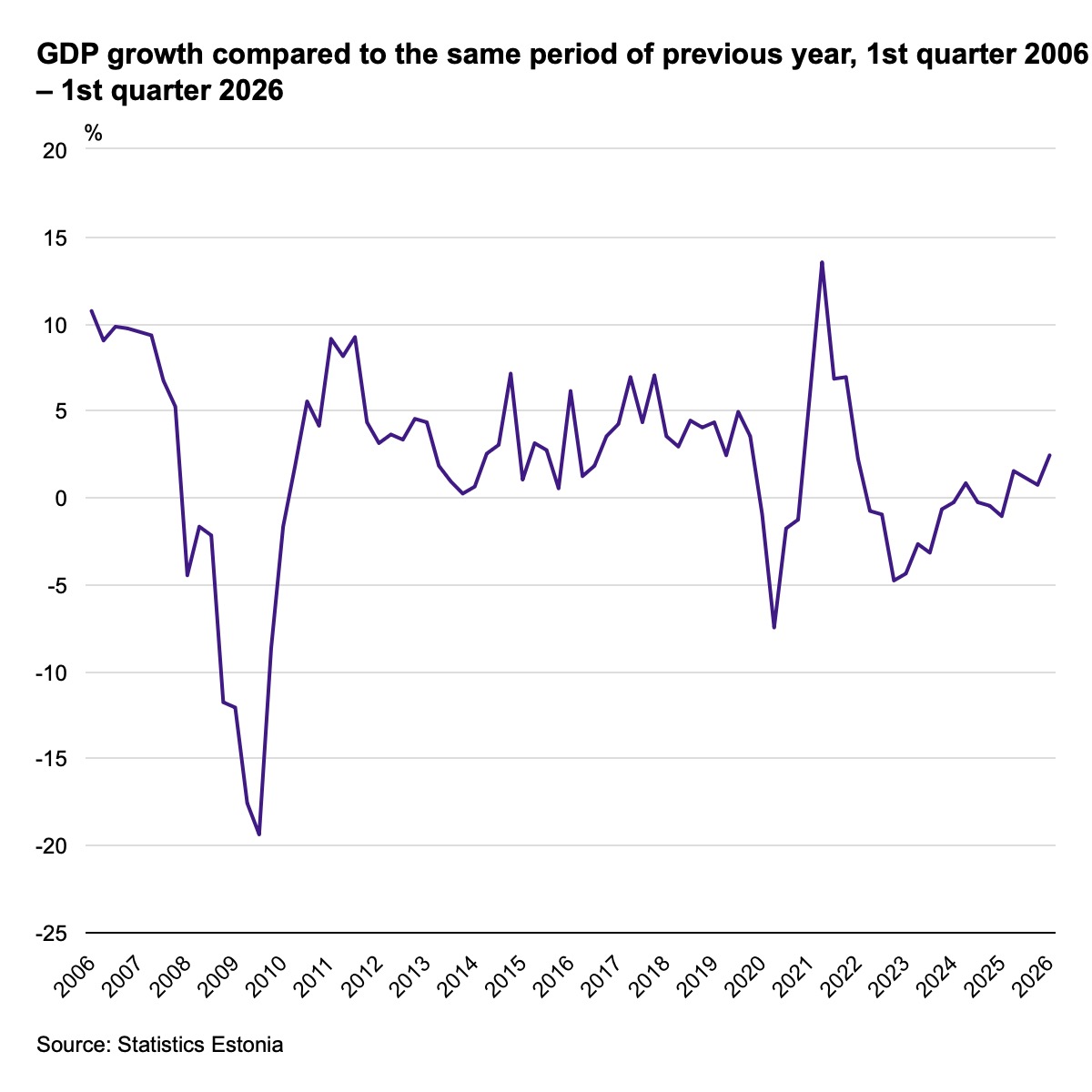
According to Statistics Estonia, Estonia’s gross domestic product increased by 2.4% in the first quarter of 2026 compared with the same period in 2025; the GDP at current prices stood at €10.2 billion.
Robert Müürsepp, the national accounts service manager at Statistics Estonia, the country’s official statistics agency, said that GDP growth was last over 2% in the first quarter of 2022. “GDP increased for the fourth quarter in a row,” he said.
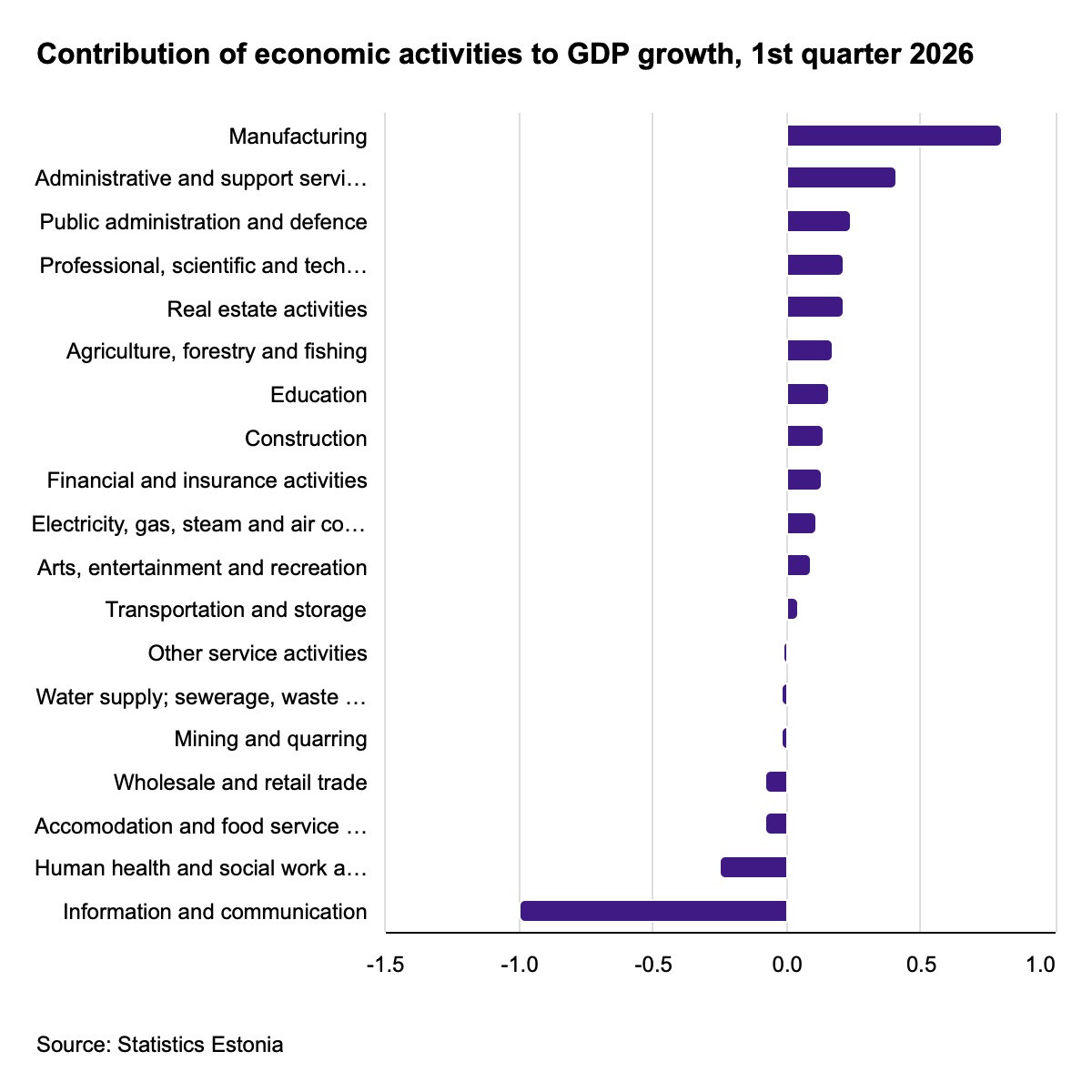
“In the case of most economic activities, their contribution to GDP in the first quarter was positive, although mostly modest,” he added, saying that, for the third consecutive quarter, manufacturing was the biggest driver of economic growth as its value added was up by 7%.
Administrative and support service activities also had a significant impact, with value added increasing by 11.6%. Other sectors contributed less to overall growth, although value added also rose in agriculture, forestry and fishing by 10.2%, energy supply by 5.5%, and arts, entertainment and recreation by 5%. Professional, scientific and technical activities, construction, and transportation and storage were also among the larger sectors making a positive contribution.
Trade was among the sectors making a negative contribution, with a slight decline of 0.8%. Information and communication had the largest negative impact on GDP, as its value added fell by 10.9%. Economic growth was also held back by human health and social work activities, where value added decreased by 4.8%. Value added also fell in accommodation and food service activities by 4.9%, mining and quarrying by 5.4%, and water supply and sewerage by 4.5%, although these sectors did not have a major impact on the overall economy.
Improvement in private consumption
In the first quarter, value added grew by 1.5%. Value added refers to the total output of enterprises after deducting the cost of inputs used in production. It increased by 0.7% in the non-financial corporations sector, 2.2% in the financial corporations sector, 2.4% in the non-profit institutions sector and 4.7% in the government sector.
“Since value added increased in almost every sector, with the exception of the households sector, we can say that the growth in the first quarter was quite broad-based,” Müürsepp said, adding that while output grew extensively, value added did not grow as much due to the rapid increase in intermediate consumption.
In the first quarter, there was a significant improvement in private consumption which was up by 4.2%. “This is the fastest growth in private consumption since the second quarter of 2022,” Müürsepp noted.
The largest increases were recorded in household spending on transport, and on recreation, sport and culture. Households also spent more on financial and insurance services, as well as on other goods and services. Spending on alcoholic beverages and tobacco was the only category to decline, while expenditure on food fell slightly.
The final consumption expenditure of the government sector increased by 4.8%, driven mainly by defence spending.
Net taxes on products accounted for almost half of GDP growth, increasing by 9% in the first quarter. Receipts from value added tax, customs duties and excise duties also rose.
Investments as low as in 2017
Müürsepp said that, although the economy improved markedly in the first quarter, the same trend did not apply to investments which decreased by 13.3%. “Investments in the first quarter have not been this low since 2017,” he explained.
Investment increased only in the government sector, by 4.4% and in the non-profit institutions sector, by 5.2%. It fell sharply in the non-financial corporations sector by 19.7%, in the financial corporations sector by 21.7% and in the households sector by 15.8%.
Non-financial corporations’ investment in other buildings and structures fell notably, by 39.5%, while investment in machinery and equipment declined by 9.6%. Households’ investment in dwellings was down by 16.6%.
Foreign trade was influenced by the increased exports and imports of fabricated metal products and gold for non-monetary purposes. In trade in services, there was a rise in the supply of various transport services as well as cultural and recreational services.
The seasonally and working-day adjusted GDP increased by 1.1% compared with the fourth quarter of 2025 and by 2.4% compared with the first quarter of 2025.