
Christmas in Estonia is less a holiday than a system of memory; it is a season shaped not only by Christianity but by climate, language and survival – by the long darkness of northern winters and by traditions that long predate the church calendar.
By December, Estonia settles into near silence. Daylight thins to a brief interlude, and the landscape turns dark and still, its winter no longer reliably white. Indoors, however, life intensifies. Kitchens become centres of gravity, filled with the smells of roasting pork, slow-cooked sauerkraut and gingerbread cooling on windowsills. The rhythm of cooking becomes a way of marking time, a practical response to winter that has endured for centuries.
The roots of Estonian Christmas lie far from Bethlehem. The word jõulud comes from the old Scandinavian jul, a midwinter festival observed across northern Europe before the arrival of Christianity. Unlike much of the continent, which adopted Latin-based religious vocabulary, Estonia retained this older term, preserving a linguistic reminder that the season was once about the solstice rather than the Nativity.
In folk belief, the winter solstice marked the moment when the sun was said to be “lying in its nest” – the darkest point of the year and the beginning of light’s slow return. This turning of the natural cycle, not a single sacred event, defined the season.
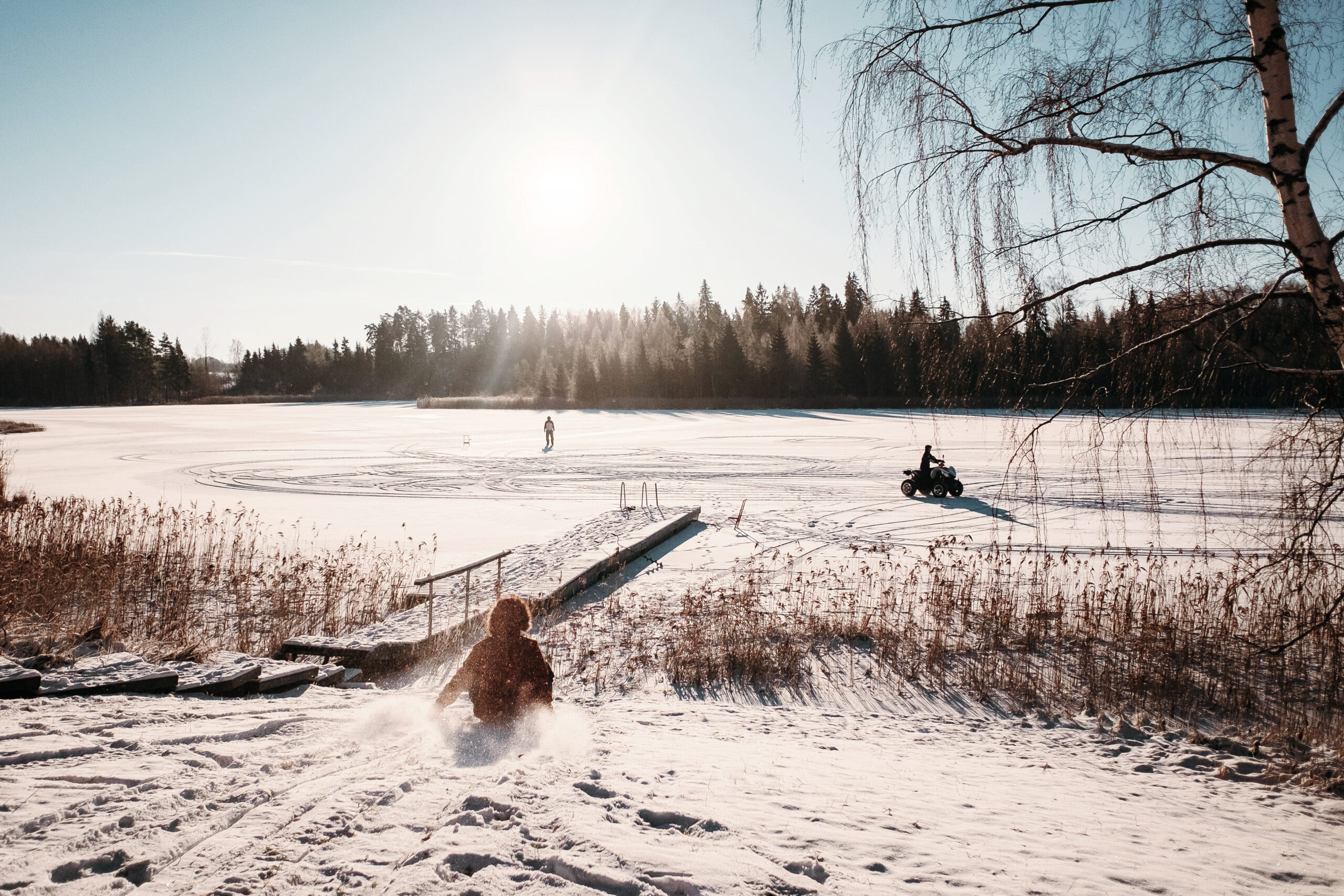
For pre-Christian rural communities, midwinter was a period governed by rules as much as rituals. Pigs were slaughtered, strong ale brewed, homes cleaned and loud work avoided. Fires burned continuously, symbolising both warmth and the sun’s anticipated return. Food was left out overnight for ancestral spirits believed to visit during these liminal nights, when the boundary between the living and the dead was thought to thin.
Many customs carried unmistakable traces of pagan cosmology. Straw or hay was brought indoors, sometimes interpreted as a symbolic covering for the earth, sometimes as an offering to animals and spirits alike. In some regions, the final sheaf of grain from the harvest was preserved until the solstice feast and used in rituals intended to predict the coming year’s fortune. Christianity did not erase these practices so much as absorb them. When church observance gained prominence, older traditions often remained intact beneath new religious meaning.
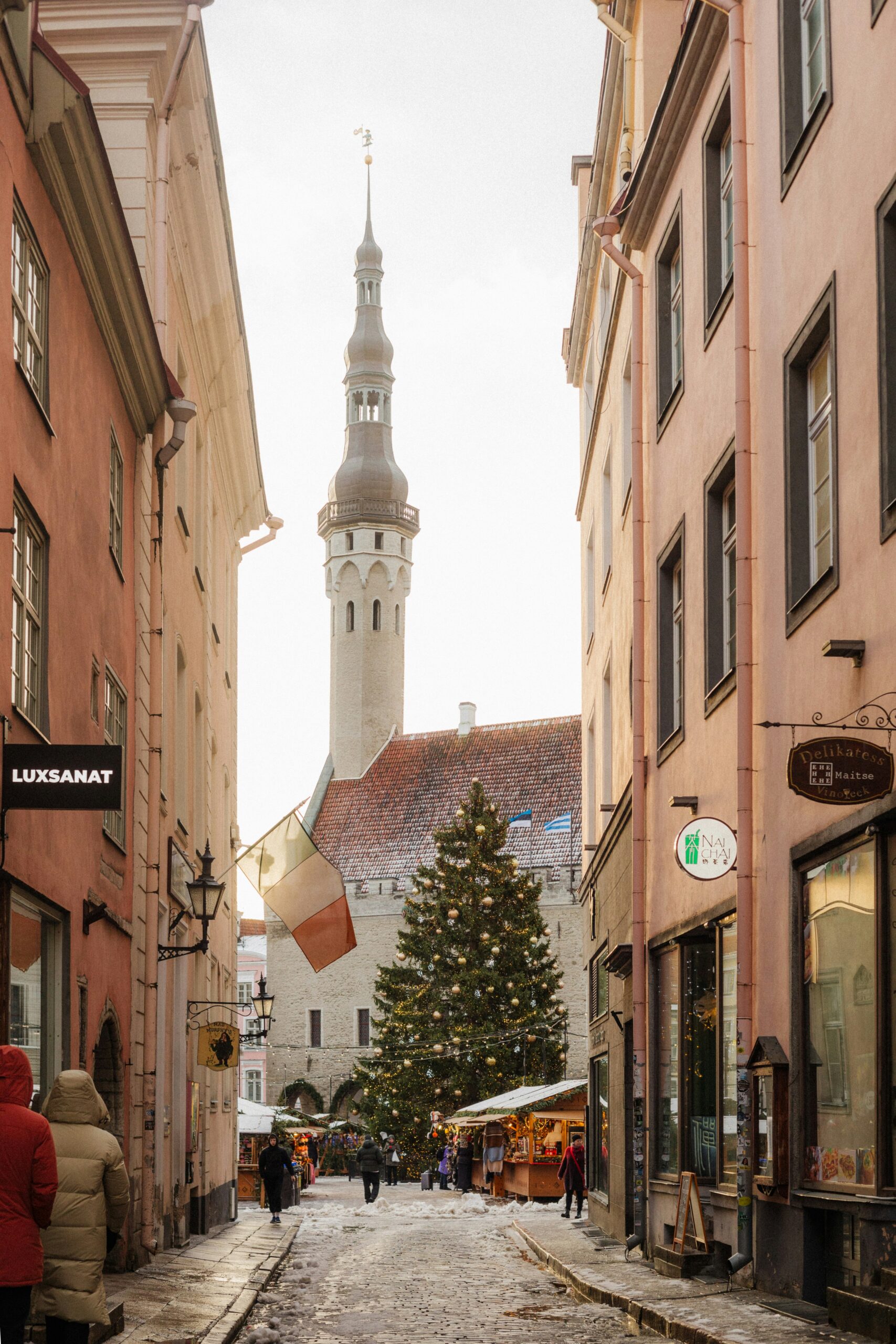
Even staples now assumed to be universal arrived late. The Christmas tree entered Estonian homes in the mid-nineteenth century via German and Baltic-German influence, first appearing in manor houses before spreading to farmsteads. Decorated with sweets and fruit, it reflected cultural exchange rather than indigenous custom.
The persistence of jõulud as a term underscores this continuity. Its lack of Latin or Greek roots distinguishes it from the Christian lexicon elsewhere in Europe. In southern Estonia, the season was sometimes known as talvistepüha – “the winter feast” – a name that centres the holiday firmly on season and survival rather than theology.
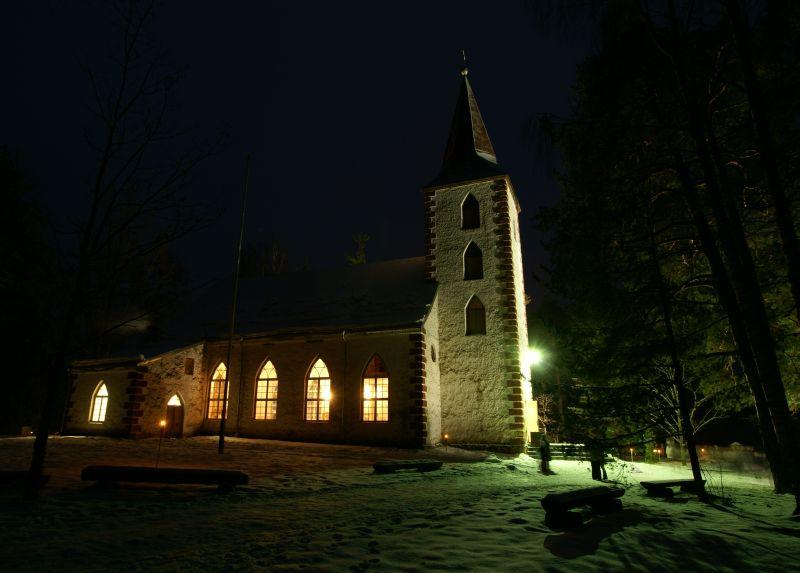
The twentieth century introduced new disruptions. Under Soviet rule, Christmas was officially suppressed and recast as a secular New Year celebration. Yet the older rituals endured privately: candles lit on graves, traditional meals prepared at home, discreet church attendance. When independence was restored in 1991, Christmas returned to public life not as a purely religious observance but as a layered cultural inheritance.
Today, Estonian Christmas reflects that history. It blends pagan solstice symbolism, Christian imagery, imported customs and modern secular practice. In a country where many people identify as non-religious, the season still carries weight – not as doctrine, but as continuity.
Historically, Christmas Eve tables in Estonia were designed to signal abundance. Families often served seven, nine or even twelve dishes, numbers chosen less for appetite than for symbolism. Few people count today, but the core dishes endure, returning each year through habit and expectation rather than ceremony.
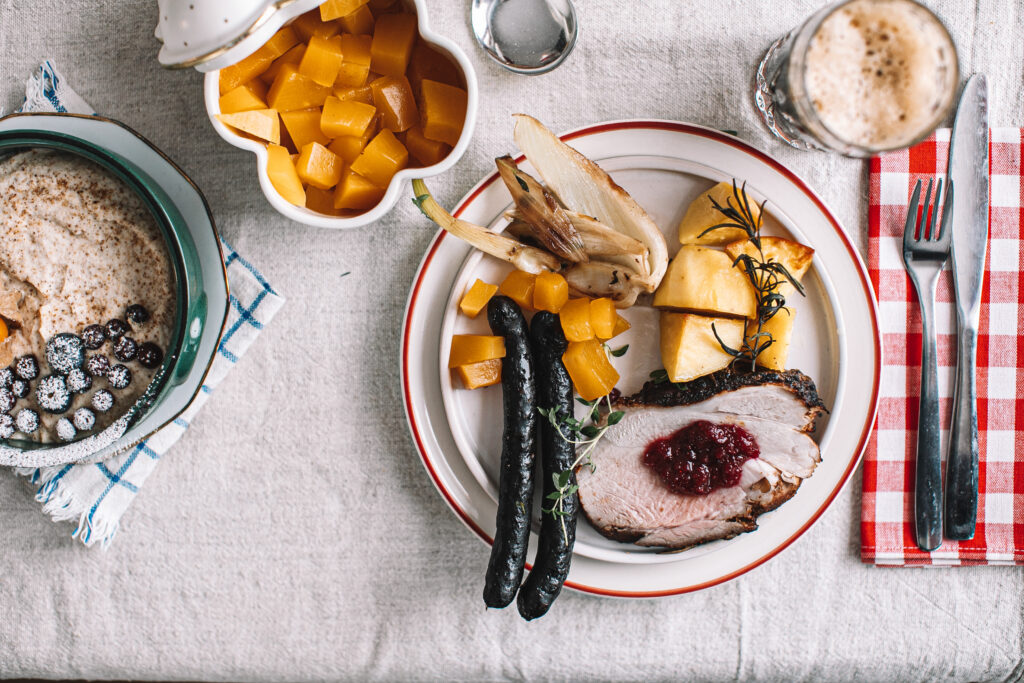
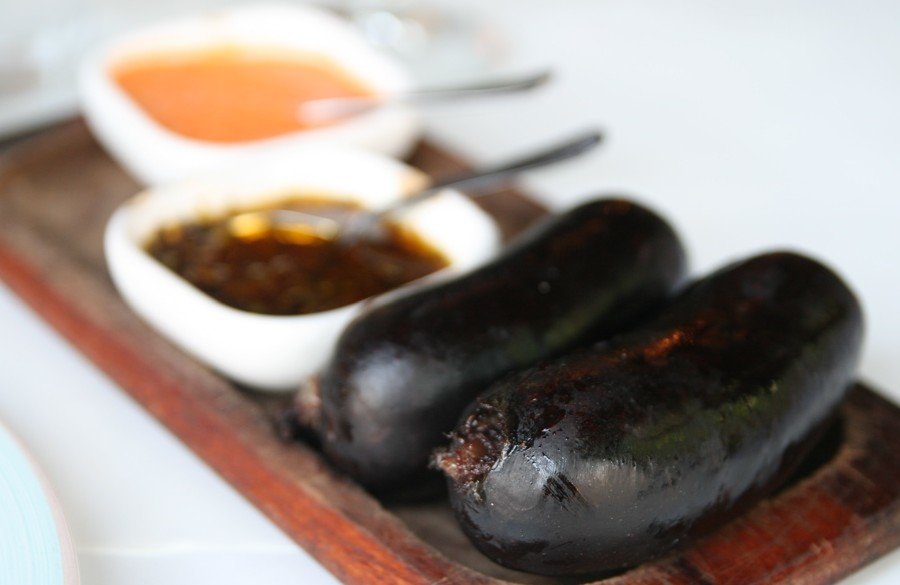
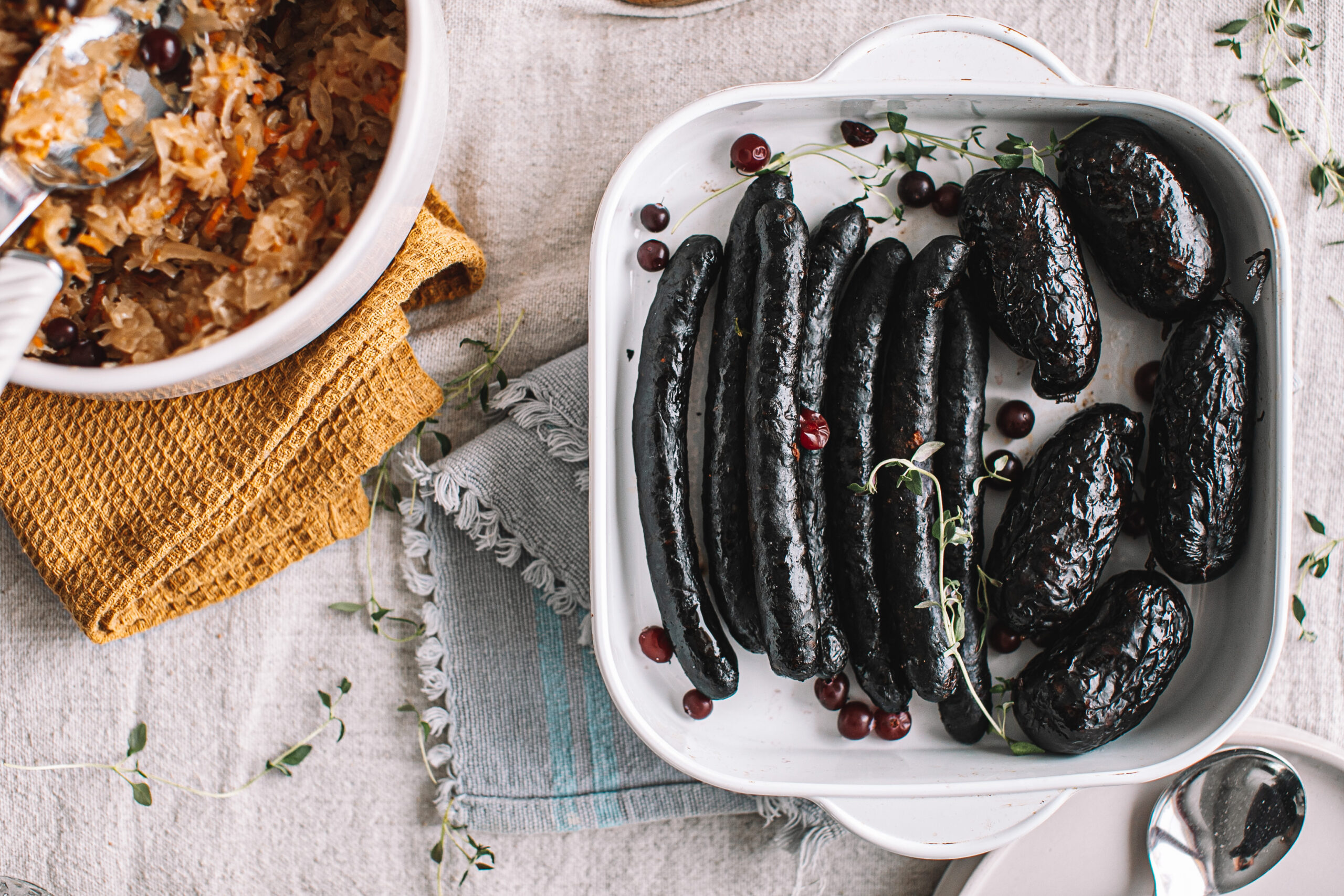
At the centre of the table is verivorst, a blood sausage roasted until the casing tightens and gives with a gentle snap under the fork. It is typically served with oven-roasted potatoes and a spoonful of lingonberry jam, whose sharp acidity cuts through the richness of the meat.
Alongside sits hapukapsas, sauerkraut cooked slowly until its sharpness softens and the cabbage turns tender, faintly sweet and deeply savoury. Together, the pairing balances fat and acidity, heft and restraint – exactly what a winter meal requires.
To help you recreate this northern Christmas table at home, Estonian World has gathered a selection of classic seasonal recipes, designed to be practical as well as faithful to tradition.
Hapukapsas – Estonian Christmas sauerkraut
No Estonian Christmas meal is complete without a pot of slow-cooked sauerkraut. It acts as the structural element of the feast, grounding richer dishes with acidity and depth. The method is straightforward, but it rewards patience. Proper fermentation and slow cooking allow the cabbage to mellow, transforming it from sharply sour to rounded and complex – a necessary counterpoint to the heavier meats on the table.
Ingredients
- Caraway seeds, lightly crushed, juniper berries or other spices (optional)
- 1 kg white cabbage, finely shredded
- Two teaspoons fine sea salt (approximately 2% by weight, essential for fermentation)
Instructions
- Finely shred the cabbage, discarding the tough core. Set aside two or three whole outer leaves for later use.
- Place the shredded cabbage in a large bowl, add the salt and mix thoroughly until the cabbage begins to release its liquid. Stir in any spices, if using.
- Transfer the cabbage and its liquid to a large, clean jar. Press the cabbage down firmly so it is tightly packed and fully submerged in its own brine.
- Use the reserved whole cabbage leaves to cover the surface of the shredded cabbage, helping to keep it below the liquid.
- Close the jar and leave the cabbage to ferment at room temperature for at least one week and up to four weeks, depending on the desired level of acidity.
- Once fermented to your liking, transfer the sauerkraut to a clean jar, seal and store in the refrigerator.
Verivorst – Estonian Christmas blood sausage
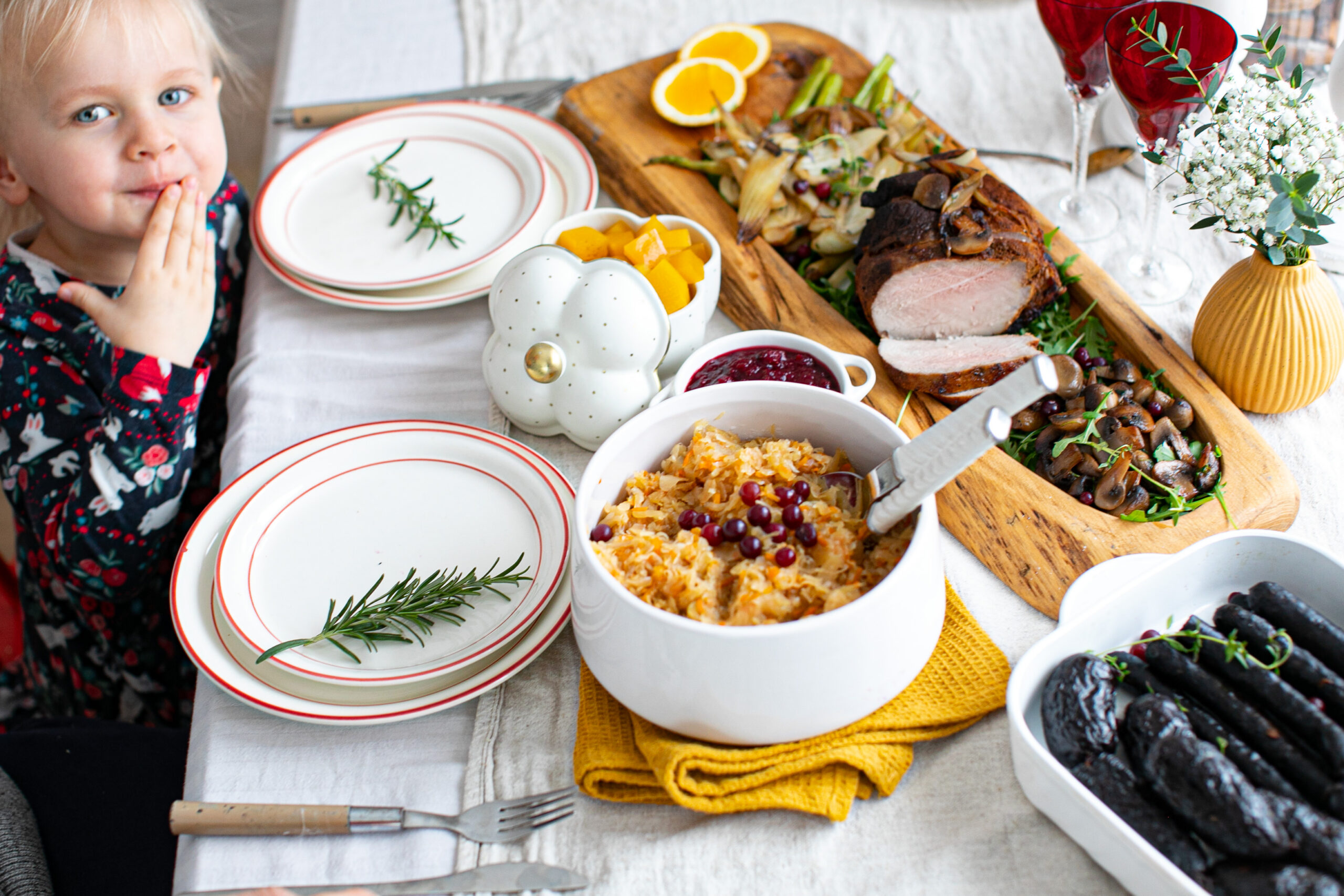
Verivorst is the centrepiece of the Estonian Christmas table. This hearty blood sausage is cooked until the barley-rich filling becomes tender and aromatic, its spices mellowed by heat. It is traditionally served with tart lingonberry sauce, plainly cooked potatoes and a generous portion of hapukapsas, whose acidity balances the sausage’s richness. Together, these elements form a winter meal that is substantial without excess, designed for the long, cold nights of the season.
Ingredients
- Freshly ground black pepper
- 1 kg pearl barley
- 350 g pork fat or streaky bacon, finely diced
- 1 onion, finely chopped
- 50 g unsalted butter
- 400 g fresh blood (traditionally pork)
- 6 pork or lamb intestines, cleaned and soaked
- 3 tablespoons fine sea salt
- 1 tablespoon dried marjoram
Instructions
- Rinse the barley thoroughly under cold water. Transfer it to a large saucepan, cover generously with water and cook gently over low heat until the grains are tender and the mixture thickens to a loose porridge. Stir occasionally to prevent sticking.
- Meanwhile, finely dice the pork fat (or bacon) and onion. Melt the butter in a frying pan over medium heat and sauté the pork and onion until softened but not browned. Season with the salt, marjoram and black pepper.
- Stir the pork and onion mixture into the cooked barley and continue cooking briefly until the mixture reaches a thick, porridge-like consistency. Remove from the heat and allow to cool slightly. Once warm rather than hot, stir in the blood until evenly combined.
- Using a funnel or sausage stuffer, carefully fill the prepared intestines with the blood and barley mixture. Do not overfill. Tie the ends securely with kitchen string.
- Bring a large pot of lightly salted water to a gentle simmer; add herbs if using. Poach the sausages for 15–20 minutes, or until the filling feels firm to the touch.
- Transfer the sausages to a baking tray and bake in a preheated oven at 190°C for about 45 minutes, turning once, until the casings are crisp and lightly browned.
Estonia’s jõulud has long been shaped by the need for light and warmth, and by the social logic of gathering during the darkest part of the year. Its food reflects that history.
The density of verivorst, the slow-cooked practicality of mulgikapsad and the spiced restraint of piparkoogid are not seasonal novelties but culinary responses to winter that predate the modern holiday itself. To prepare these dishes today is to participate, however modestly, in a tradition built around endurance and continuity – one that carries Estonia’s long relationship with winter from one generation to the next.

