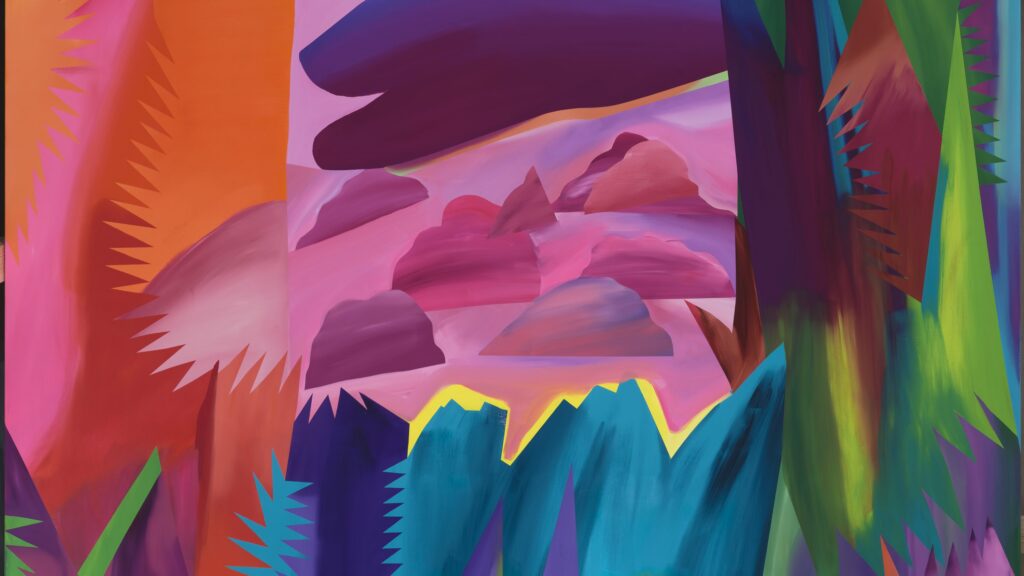
Estonian artist Kristi Kongi’s Chromatic Drift turns the great hall of Kumu, Estonia’s leading art museum in Tallinn, into a luminous and unsettling journey through colour, memory and the inner weather of the artist’s mind.
A review of Kristi Kongi’s Chromatic Drift at Kumu
There is another sky,
Ever serene and fair,
And there is another sunshine,
Though it be darkness there…
– Emily Dickinson
In her new solo exhibition, Chromatic Drift, Kristi Kongi has transformed the great hall at Kumu into a pulsating and powerful parallel universe, in which the paintings on display feel like sudden thoughts, fleeting impressions and ephemeral fantasies – all dashing madly through an artist’s mind.
Chromatic Drift begins with a winding descent into the great hall, where the windows looking out onto the Kumu courtyard have been covered with clear and richly coloured ghosts. These spectral figures are far from menacing, but they do signal that we are about to enter an alternative spiritual dimension filled with more darkness than light.
As we reach the end of our descent and turn into the great hall, we are drawn into a cave that takes its title from Georges Bataille:
“Human existence is only possible with animal existence as its basis.”
The cave itself contains a few primitive figures that resemble birds and livestock, but it is mostly an uncanny mix of jagged rock, eerie shadows and sharply pointed stained glass, suggesting that our relation to nature is fraught and tinged with fear and violence.
When we retreat from the cave, we are confronted with the vast space of the great hall and immediately see that its expansive floor and enormous walls have been turned into a landscape in which there is another sky, somewhat serene and fair, and another sun, though it is darker there.
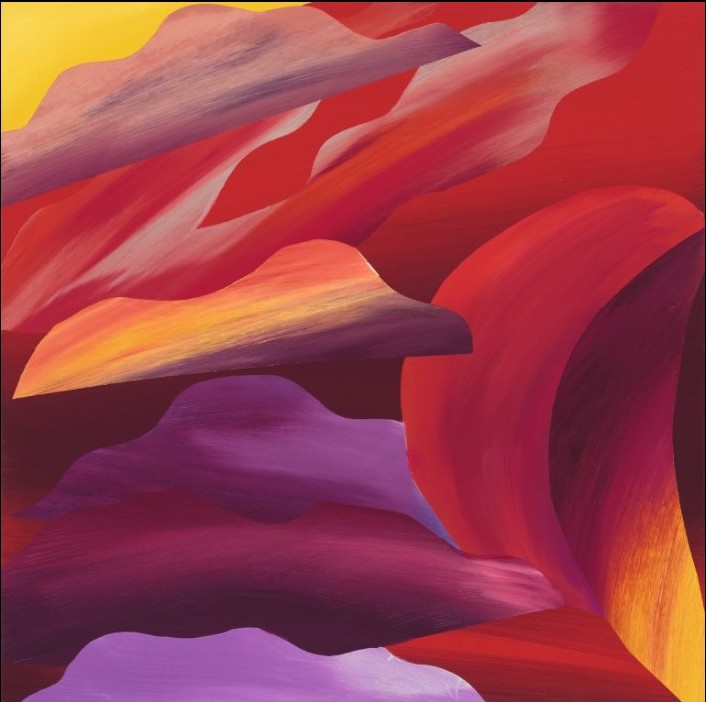
The deep purples and pinks that cover the walls and creep onto the floor are used repeatedly in Kongi’s individual paintings, and her use of the same colour scheme across the whole of Chromatic Drift gives the viewer the sense that they are not looking at a set of distinct artworks, but are instead immersed in a total installation that is nothing less than Kongi’s imagination.
As we enter the artist’s mind, we encounter a collection of staircases scattered at random across a green patch in Kongi’s psyche. The staircases themselves are multicoloured and vary in size, and they create a sense of movement within the installation insofar as they point the viewer in several different directions at once.
The various staircases appear to go nowhere. But after climbing a few of them, we realise that they mark the boundary between physical reality and the mind and thus serve as launchpads for thought.
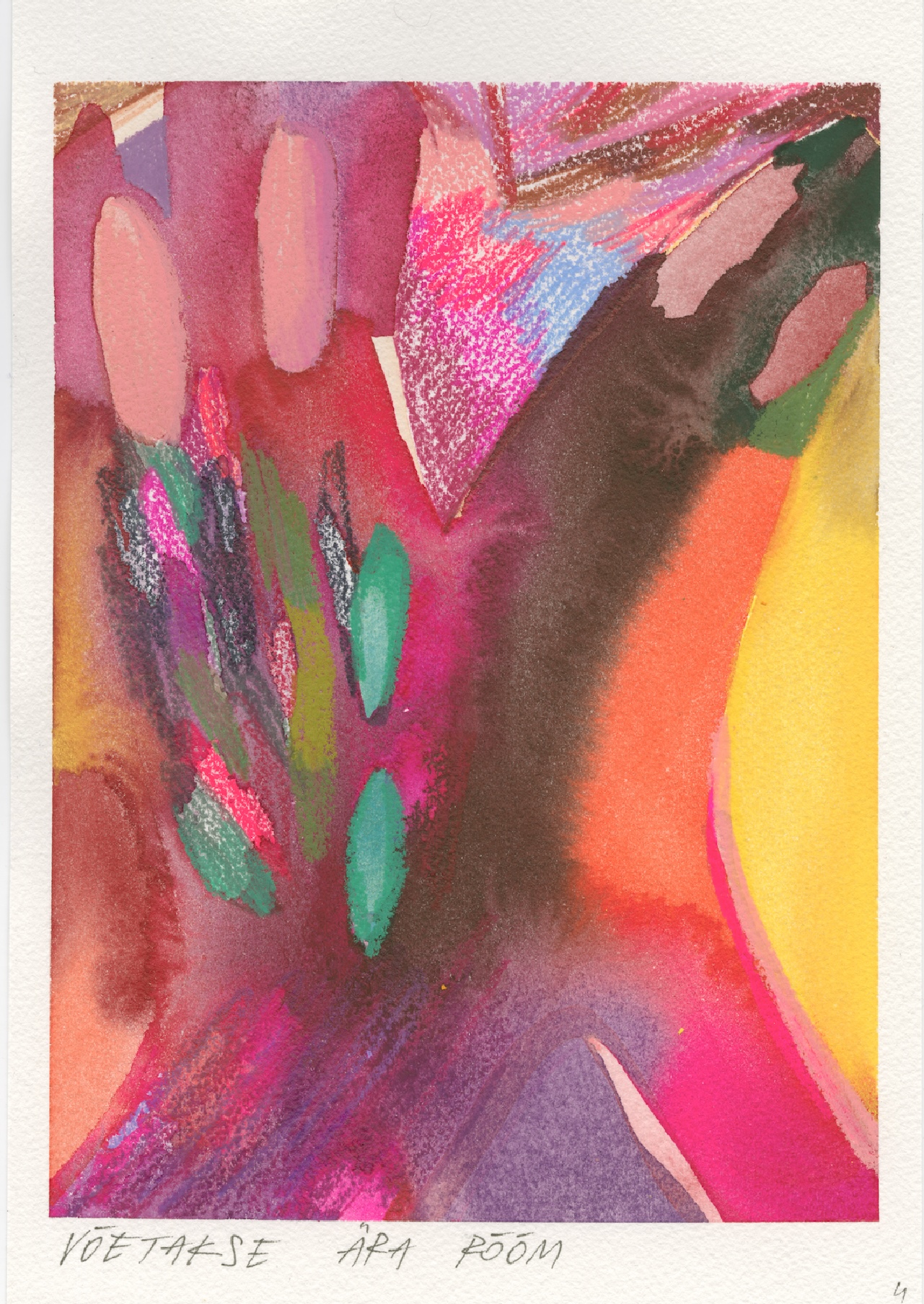
The thoughts flying through Kongi’s psyche are caught in a series of small watercolours that run along the walls of two temporary corridors set up within the installation, to which the viewer is drawn after exiting the cave and climbing several staircases.
Labels on the watercolours range from philosophically debatable claims, such as “we can’t live without love” and “everyone wants to rule the world”, to simple descriptions of sensations, including “I feel sad today” and “joy has been taken away”.
Although small in size, the watercolours serve as potent expressions of Kongi’s thoughts and feelings. Compositionally, this potency is achieved through the artist’s exclusive use of deformed and ghostly figures painted in vivid reds, bright yellows and dark greens that bleed into the principal purples and pinks. Clearly, Kongi is haunted by the inner workings of her mind. And, by extension, so is the viewer.
Exiting the watercolour corridors, we are pulled towards a massive orange sun setting on the back wall of the great hall, around which a set of pocket-sized oil paintings float aimlessly in a lilac and lavender atmosphere.
Some of these paintings extend the philosophical debate Kongi is having, with headings that ask: “Aren’t violence and meaninglessness ultimately one and the same?” But we increasingly encounter landscapes that offer a detailed account of the geography that constitutes Kongi’s psyche.
If the watercolours were dominated by anguish and agony, the small oil paintings give way to a plaintive mood, where “darkness is able to find me and you”, but where there is room for “morning light” and “morning hope”, too.
The purple and pink intensity continues. But the blue skies, orange plains and green hills sketched on these minor canvases prepare the viewer for a series of monumental paintings at the centre of Kongi’s immersive installation.
Here, the unwieldy vegetation of Kongi’s imagination is on full display, with a mixture of abstract landscapes and figurative paintings bearing names such as “When Heaven and Earth Meet” and “People Don’t Know How to Be Human”, of which “Open Heart” is the most powerful and important.
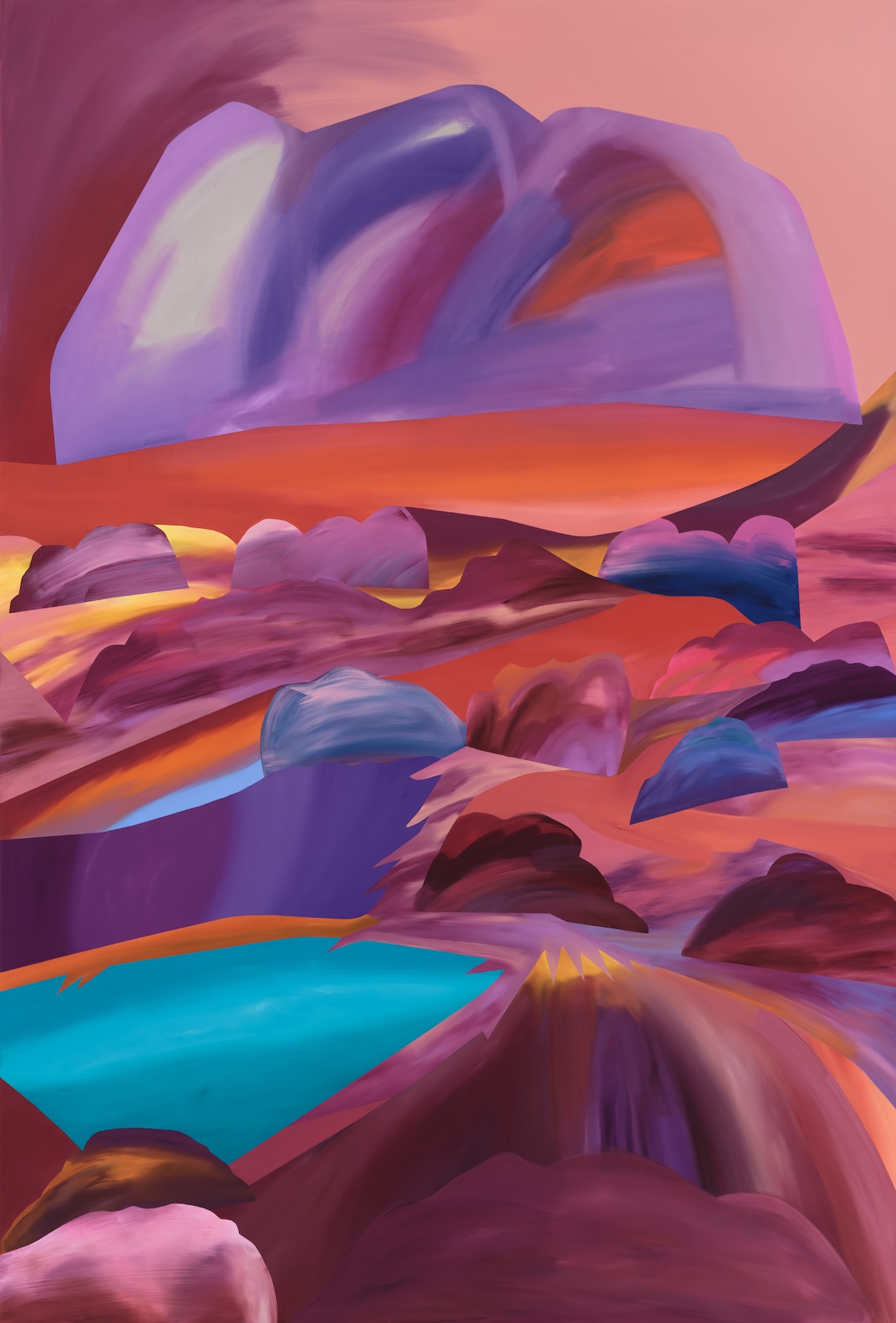
“Open Heart” is a sonorous and stormy landscape. At the bottom, a bright blue lake asserts its existence against a red and violet mountain with razor-sharp orange peaks that resemble claws or teeth poised to tear the scene apart. In the middle, purple and blue clouds are stretched and stranded across multiple horizons. And at the top, a purple canopy hovers patiently but forebodingly over the face of the earth, as if God were waiting to pass judgement on the chaos below.
Taken together, it is evident that this “Open Heart” is still beating. But equally, it has been battered and bruised over the course of history. And while there are traces of positive white and yellow light in the painting, Kongi’s placement of “Open Heart” at the centre of Chromatic Drift implies that if we expose our minds to others, our hearts are vulnerable, too.
Exposed and vulnerable, we fumble our way into a final dim and cool side room that is enveloped in deep but soft orange paint, and we cannot help but feel that we have escaped the heat of the day.
This impression is confirmed when we see the first of three abstract mixed plywood and watercolour paintings, entitled “The Smell of the Moon Left This Room Empty but So Close”. The second work, “Home Is Where the Heart Is”, inevitably puts us at ease, whereas the third and final piece, “I Can See the Sea Clearly, Bright and Deep”, suggests that some wisdom has been gained over the course of Kongi’s exhibition. But what might that wisdom be?
To my mind, Chromatic Drift illuminates the trials and tribulations we face when we open ourselves up to others. Yet the power of the exhibition as a whole also shows that sharing our sudden thoughts, fleeting experiences and ephemeral fantasies with our fellow human beings is well worth the risk. So, I very much encourage each and every reader to visit Kongi’s exhibition at Kumu before it closes on 11 October 2026.
This essay was originally published in Estonian translation in Sirp on 19 June 2026.