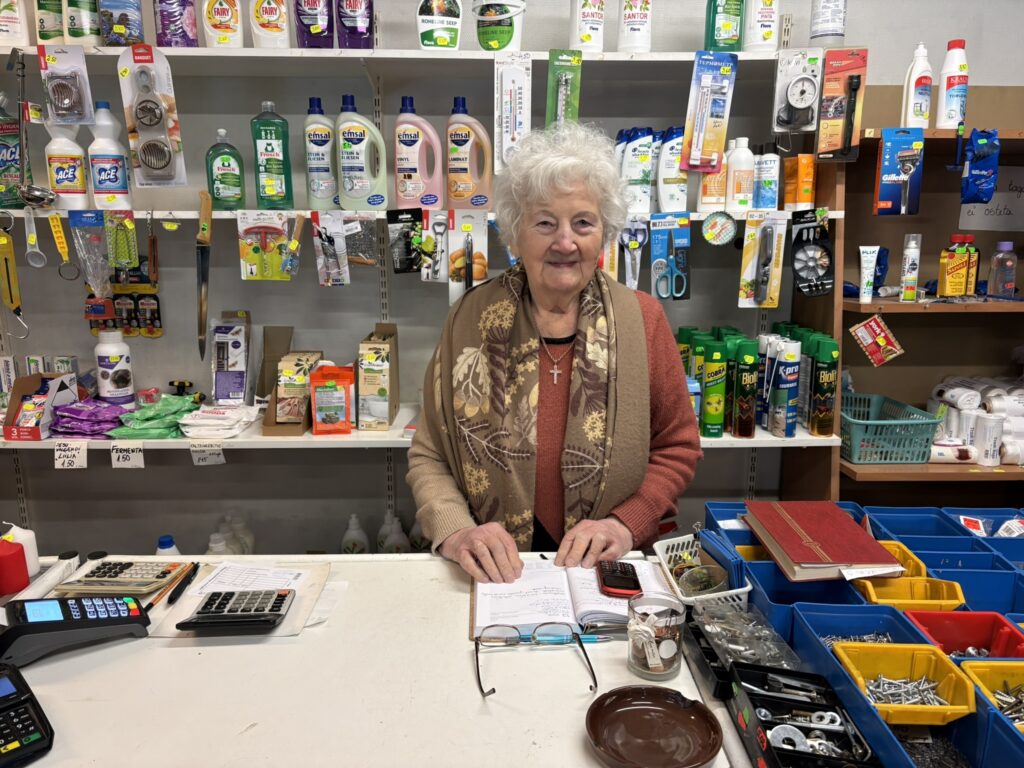
In Tallinn’s fashionable Kalamaja district, where old wooden houses now sit alongside trendy cafés and rising property prices, Alma Sooäär still runs her tiny household goods shop much as she always has – with no discounts, no marketing plan and no intention of going anywhere.
In an age when shopping baskets are filled with a click, retail is driven by algorithms and consumers are swept along by Black Fridays, flash sales and carefully engineered urgency, Alma Sooäär’s shop moves to an altogether different rhythm. Here, commerce advances not in waves but in small, steady motions – one dustpan, one enamel pot, one handful of screws at a time.
The bell above the door still rings for every customer. There is no self-checkout, no security system worth mentioning, no manager tucked away in a back office. Alma, who recently turned 90, is the security, the sales assistant, the cleaner and the proprietor all at once. Her little shop on Kalamaja’s main street has been here so long that many newer residents can scarcely imagine the neighbourhood without it.

When Alma celebrated her 90th birthday in early January, it felt, for a moment, as though all of Kalamaja stopped to mark the occasion. Local Facebook groups filled with warm wishes. The Kalamaja Community Museum began collecting photographs and memories. Radio and television journalists came by. President Alar Karis and the First Lady visited in person. Alma’s counters, usually piled with bread bins, clothes pegs, tablecloths, sieves, candles and assorted household essentials, were suddenly crowded with bouquets and embraces as well.
“The president bought two enamel pots, a dustpan and a drain-cleaning product,” Alma says, still visibly pleased. “He paid by card.”

I first met Alma eight years ago while writing about her for the community book There Is Kalamaja in the Air. Since then, many of the shops and cafés that once seemed part of the area’s permanent character have vanished. Some much-loved local residents are gone too. But Alma’s shop, which opened in Kalamaja in 1997, remains. The bell still rings six days a week, and Alma is still there behind the counter – upright, bright-eyed and sharp as ever.
When she first started out, she reminds me, the markup on goods was just 0.7 per cent, calculated by hand on an abacus.
“You didn’t dare add more,” she says. “Otherwise someone might accuse you of profiteering. In the 1990s, retail was still finding its shape. I had to work out for myself what sort of markup was acceptable, without getting into trouble with the authorities.”
Today, the markup is 50 per cent.
“I couldn’t keep it that low forever,” she says evenly.

The business must sustain itself, but Alma has never been particularly troubled by competition.
“I do my own thing. This is my hobby, my passion. I don’t pay myself a salary.”
According to Estonia’s business register, the shop recorded a taxable turnover of €6,061 in the third quarter of 2025. Alma, however, believes the real secret of its endurance is simpler than any business theory: here, there is a bit of everything.
That becomes clear during the interview, as the door opens again and again. Someone comes in asking for flypaper, which Alma does not currently have, but she promptly telephones around to try to get hold of some. I help her cut two lengths of oilcloth. A man buys five screws and asks the price.
“Oh, what can they cost?” Alma says, and names 30 cents on the spot.

Then another well-wisher appears with a gift bag of sweets and birthday congratulations. Roughly half the customers who step in speak Russian. The traffic is constant, casual, unhurried – the opposite of modern retail theatre.
The best-selling items are practical rather than fashionable: dustpans, floor-care products, enamel pots and bowls, cleaning agents and pest-control supplies. Rat poison, Alma says, sells especially well.
“There are a lot of rats around here,” she says matter-of-factly. “You get through plenty of poison. At one point people were saying you shouldn’t be allowed to kill rats at all. Well then, with all this construction work, things would become impossible.”

Alma says people have asked not only for products but also, jokingly, when there will be a tram named after her.
“That will probably happen once I’m no longer here,” she says.
It would not be the first time her name has travelled beyond the shopfront. Years ago, when Laeva Dairy – now Valio – launched its Alma milk and curd snacks, Alma Sooäär was chosen as the face of the campaign.
“I already existed,” she says lightly. “They came to introduce themselves and even asked permission to use my name on the curd snacks.”
At one point, her face was visible even at the Tallinn Song Festival Grounds.

These days, Alma is in the shop every day. She once had a beloved assistant who worked there for 30 years, but she has since retired and now looks after her grandchildren. She still drops in about once a week to help. During my visit, she arrives, picks up a broom and begins sweeping almost immediately. Otherwise, Alma runs the business alone. Her daughters help with the bookkeeping, and together they exchange ideas about the shop.
When I spoke to Alma eight years ago, she said the only thing that really kept her away from work was foreign travel, which she still enjoyed from time to time.
“I don’t travel any more,” she says now.
Partly that is down to age. Partly it is because business has become quieter, especially since the pandemic.
“Sales fell very low then. I kept the door open so people could come in one by one. Every customer mattered,” she says. “But I manage.”

Across the road stands a Ukrainian café, where Alma recently celebrated her birthday. Staff from there sometimes come into the shop, and the war in Ukraine weighs heavily on her mind.
“I hope war can be kept away from us,” she says.
When I ask whether she has often felt fear in life, Alma thinks for a long moment and then says perhaps not really. She grew up in Virumaa, where her mother raised nine children alone after Alma’s father died young. They were not rich, but neither were they destitute. The children, nicknamed “field hares” – Alma’s maiden name was Põld, meaning “field” – ran each morning across open land to their private school.
During the Stalinist deportations, Alma’s family was included on a list of those marked for exile. She was too young to understand what was happening, but someone managed to access the list and remove their name.
“I remember that my mother had already packed,” Alma says. “She was ready to go with us.”
There is no country but Estonia where she would want to live.
“Estonia is a peaceful country,” she says. “I hope it stays that way.”

Her life, like many long lives, has held work, love and grief in equal measure. She married young after meeting her husband through folk dancing. They danced both folk and ballroom, and soon had two daughters. Her first husband died at 40. Later she lived for 20 years with a well-driller, who died of leukaemia. After that came nine years with a man from the film world, who died at 90.
Now there is, as Alma puts it, a “heart’s delight” in her life: a man two years older than she is, who comes to the shop nearly every day, jokes with her and goes walking with her.
“When the president gave me a state decoration two years ago, I joked that he was my fifth man,” she says, breaking into laughter. “He told me he would come and visit me. Oh, I do like him. He has such a friendly face.”
A little later, she adds in a softer voice that she regrets not giving the president a kiss.

Kalamaja itself – one of Tallinn’s best-known and fastest-changing districts, now firmly established as a fashionable enclave of old wooden houses, young families, tourists and cafés – has transformed dramatically in Alma’s lifetime. In her eyes, it has become cleaner, more important and more respected. There is more culture, more movement, more life. She likes that. But the shop remembers rougher days too. In the beginning, drug users sometimes came in. Later, they disappeared. There have been no serious quarrels in the shop, she says. Customers are generally cheerful.
For Alma, age is a number, not a condition. What keeps a person fresh, she believes, is staying active. Today that means running the shop; in earlier years it meant singing and dancing. She once competed in ballroom dancing – tango was her favourite – and sang in a choir.
“If you begin doing something when you are young, you carry on doing it when you are older,” she says.
As the years have passed, she says, friendship has come to mean more to her.
“When I was young, I didn’t understand that,” she admits. “I didn’t appreciate friends or men enough. Now I think you have to be a good person yourself too, not simply expect everything from others.”
To age with dignity, in Alma’s view, means still being able to do something meaningful – and knowing what one is doing.
“You must create important things for yourself,” she says.

It occurs to me that Alma’s remarkable briskness may also have something to do with the shop’s temperature. After an hour inside, wearing four layers and trying to type with cold hands, I am beginning to stiffen. Alma, meanwhile, is standing there in a simple jumper. The shop is heated by three radiators, which together raise the temperature to about 15 degrees Celsius.
If there is one value she would pass on, it is honesty: honesty towards oneself, towards one’s business and towards other people. She also believes, deeply, in action – in the near-magical force of actually doing the thing one dreams of doing.
“You mustn’t waste time,” she says. “You have to act.”
I suggest that courage may be one of her defining qualities. She agrees. When I ask whether being a woman made it harder for her to go into business, Alma dismisses the idea. She has always believed in herself and in other women. At the same time, she says, women’s role in society has clearly changed.
“Women do important things from a young age. They are active. In culture, women are even more active,” she says. “Now I see that women belong everywhere – in culture, politics, business.”
In the beginning, people warned her not to do it. How could she dare go into business? She would go bankrupt, they said. Men who did not dare take the risk themselves asked whether she was not afraid.
She was not.

When I ask how she would like to be remembered – and how she would like her shop to be remembered – Alma smiles and says it would of course be nice if people still spoke about it later.
“People tell me all the time that I mustn’t close the shop,” she says.
And what is the greatest wealth of her life?
Her family, she says without hesitation. Her children, grandchildren and great-grandchildren, all living their own lives yet always returning much like the people of Kalamaja returning, again and again, to Alma’s shop.
And then, once more, the bell rings.