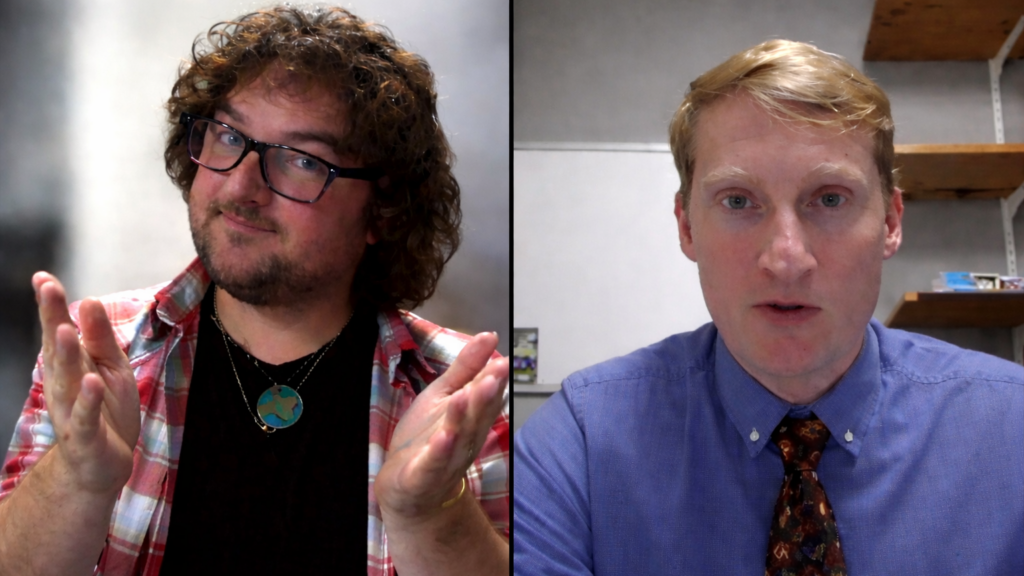
In the latest episode of The Tallinn University Podcast, Professor Matthew Crandall joins host Terry McDonald to unpack one of the most pressing questions in international politics today.
The conversation opens with the broader erosion of international norms. While the current geopolitical moment may feel exceptionally turbulent, Crandall argues that many of the forces behind it have been building for years.
Reflecting on developments since Russia’s annexation of Crimea in 2014, he notes that actions once considered politically unthinkable are gradually becoming more commonplace.
“There were certain norms that were seen as off limits,” he says, “but slowly those norms begin to erode.” In his view, the return of large-scale interstate conflict suggests that some of the core assumptions of the post-Cold War era are now being fundamentally challenged.
The discussion then turns to the Trump administration’s approach to Iran. McDonald points to the range of public justifications offered for military action, raising questions about the coherence of US strategy.
Crandall suggests that, beneath the often chaotic messaging, the administration appears to be pursuing two broad objectives: weakening Iran’s military capabilities and pressuring the regime to change its behaviour. At the same time, he notes that the administration’s communication style can make it difficult to identify a clear and consistent strategic narrative.
A central theme of the episode is how smaller states respond to uncertainty among great powers. Drawing on his research into small-state foreign policy, Crandall argues that alliances often function less as moral partnerships than as practical security arrangements.
“Your alliance is like an insurance policy,” he says. “You pay premiums.” For countries such as Estonia, maintaining strong alliances may be essential even when policy disagreements emerge.
The episode also explores how recent geopolitical shocks are reshaping European defence debates. Russia’s full-scale invasion of Ukraine and growing uncertainty around US leadership have prompted renewed discussion about strategic autonomy and military capability.
As Crandall observes, many policymakers had long wondered what might finally push Europe to strengthen its defence capacity. “What would it take for Europe to increase its defence capabilities?” he asks. “It turned out the answer was Vladimir Putin and Donald Trump.”
Taken together, the discussion presents a picture of an international system undergoing adjustment rather than outright collapse, as states large and small rethink their strategies in an increasingly uncertain world.
You can also listen to the conversation on Apple Podcasts.
The Tallinn University Podcast is proudly distributed in cooperation with Estonian World.