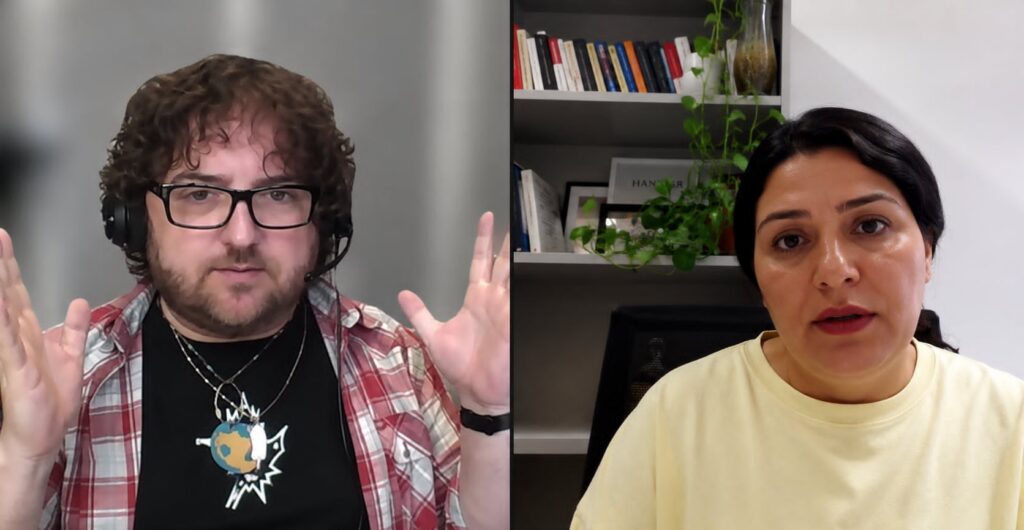
As the war with Iran is told through the language of missiles, presidents and military commanders, the voice of ordinary Iranians risks disappearing from the story; in this episode of the Tallinn University Podcast, Iranian activist, poet and Tallinn University researcher Maliheh Keshmiri speaks about life after the blackout, the regime’s brutal crackdown on protesters and why, despite everything, she still believes her daughter will see a free Iran.
“Even if I am not alive to see a free Iran, I can now say with certainty that my daughter will see it.” – Maliheh Keshmiri, in this episode.
Coverage of the war with Iran has been dominated by narratives about leaders: Donald Trump, Pete Hegseth, Ali Khamenei and the IRGC. Yet the voice of the Iranian people – those who rose up in January and were slaughtered for it – has been largely lost.
In this episode, we seek to change that. I interview Maliheh Keshmiri – a friend of the podcast, Iranian activist, poet and Tallinn University researcher. Maliheh has joined us at previous pivotal moments for Iran: in season three, during the Woman, Life, Freedom movement, and earlier this season, amid the brutal crackdown on protesters in cities across the country.
Now, as the war reaches a critical stage, Maliheh returns to share her insight into what is really happening to the citizens of Iran. On the morning we spoke, she had managed to talk to her mother for the first time in 85 days.
“I tried my best not to cry, and I succeeded in a way. My mom was laughing, and I was missing that. I was living for the moment that the internet would be connected again and I could see her face laughing. She said something that made me laugh even more. She had so much hope. She said: I started drying peppermint, wild peppermint, for you. Because I know that the regime will go and you will be coming home very soon, so you will need dried peppermint.”
She spoke about the true death toll from the regime’s brutal crackdown on peaceful protesters in January.
“The official numbers are over 42,000 people. But what we understand from the videos and from the calls from inside the country is that in every single street there were hundreds of killed protesters. I personally think it was well over 100,000. Because from small, small villages whose names I have never even heard, there were numerous people – 50 people, 14 people, 20 people – in very small villages that barely had 30 households. So my estimation, which I can take responsibility for, is way over 100,000 people killed in just two nights.”
She spoke to me about the economic devastation in the country, and how the regime’s priorities are fueling popular backlash.
“The average worker’s wage will buy barely four pizzas. Per month. After discovering that there were these huge facilities underground for missiles – what the United Arab Emirates is building on earth for its people, the Islamic Republic spent way more to build underground, to put their people in danger. Billions and billions of dollars for making these cities and keeping people in poverty. All this time, when they were talking about sanctions, about all the things that made people live in poverty – of course there was money. They spent it not for the people, but for their missile towns.”
She even raised the possibility of armed groups, including Kurdish forces, rising up against a weakened regime.
“We are talking about the most murderous regime in history. Even if they are armed – when people are afraid of turning on their Starlink to send a message outside… I can give you at least one example: someone was executed, hanged, because of having Starlink internet. My heart, deep down, I believe that something will start from Kurdistan. But I cannot expect them to put their lives in danger. They were always pioneers in leading the strikes against the government, and they will do it again.”
The conversation was powerful and wide-ranging, so we have split the episode into two parts. The second half will be released later this week – so be sure to subscribe.
The Tallinn University Podcast is presented in cooperation with Estonian World.