Estonian World’s executive editor, Sten Hankewitz, drove his all-electric Ford Mustang Mach-E – affectionately known as his “Pony” – from central New Hampshire to Toronto and back; he not only survived the long solo journey but found that driving an EV helped keep him sane along the way.
When Estonian World’s editor-in-chief, Silver Tambur, asked whether I wanted to drive to Toronto to cover KESKfEST, an Estonian festival held at the nearly completed diaspora centre KESKUS, my first reaction was, “Hell to the no.” Six hundred miles each way? Jebus. I would go insane – and then some. There was also the small matter of my car: an electric Ford Mustang Mach-E that I affectionately call my Pony. The trip had all the hallmarks of a doomsday journey, destined to end with me stranded in the middle of nowhere, the battery dead and nobody coming to my rescue.
But it made me wonder: could this be the perfect test of whether a long road trip in an EV was actually feasible? A few years earlier, I had read a Wall Street Journal article chronicling four drivers on separate EV road trips. None came away happy. Limited range, broken chargers and other setbacks turned each journey into a headache, leading the drivers to conclude that we were not yet ready for mass EV adoption.
So, now that it is 2026, are we ready? Truth be told, I am not sure I can answer that question definitively. After all, driving from central New Hampshire to Toronto is hardly an expedition into the wilderness. Charging hubs were plentiful along the route, so provided I kept an eye on my remaining range, becoming truly stranded seemed unlikely – if not impossible.
Then again, there were still risks and challenges. What if a charger did not work? Would I make it to the next one – and would that one work? Would it be fast enough? Would I even reach Toronto that day? At 600 miles, the drive would take at least ten and a half hours even without charging stops, so every minute mattered. I had to reach Toronto that evening because the festival began the following morning. Plenty could still go wrong.
Plan on more stops rather than fewer
And so I thought: let’s do it. Best-case scenario, I would meet new people, report on an important event, write this very article and reunite with my Canuck friend Jason, whom I had not seen in 12 years. Worst-case scenario? Well … “It rubs the lotion on its skin”?
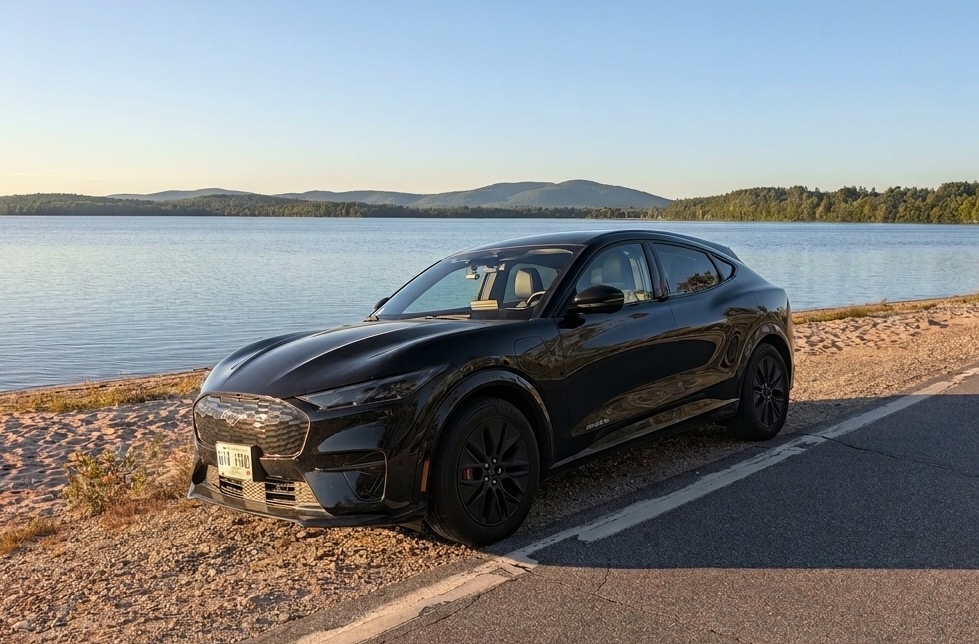
Let’s begin with a few figures for the Pony. Mine is the Premium model, fitted with a 91 kWh extended-range battery. Its official range is 300 miles (480 km), although the distance it can actually cover depends heavily on where and how it is driven. Unlike a petrol-powered car, an EV generally consumes more energy on the motorway and less in slow-moving city traffic. In mixed city and motorway driving, I usually achieve between 3.3 and 3.7 miles per kWh (16.8–18.9 kWh/100 km). Travelling at 70 mph (112 km/h) or more, however, drains the battery considerably faster.
Taking that into account, I asked Gemini, Google’s AI assistant, to plan a route from my home to Toronto. I had assumed that, for a journey of roughly 600 miles, two charging stops would be more than enough. Fortunately, I listened to that fledgling incarnation of the Terminator, which strongly advised me to allow for three or four. Even starting with a fully charged battery, I would not have made it with only two stops, while three would have been cutting it close. Four proved to be the optimal number.
I left home at 8:05am with the battery at 84 per cent and an estimated range of 244 miles. My first stop was near Concord, New Hampshire’s picturesque state capital, where I arrived at 9:28am. I had covered 60 miles at an average efficiency of 4.1 miles per kWh (15 kWh/100 km) – an excellent result, although most of the journey had been along slow country roads.
My next charging stop was in Latham, New York, near Albany – the rather hideous state capital. I left Concord at 9:57am with the battery at 90 per cent and an estimated range of 266 miles, arriving in Latham at 1pm. I had covered 144 miles, and the Pony showed 114 miles of range remaining, a 41 per cent charge and an average efficiency of 3.5 miles per kWh. In other words, I had used only eight miles more range than the car had predicted – again, not bad at all.
Highway driving drains an EV battery faster than you might think
I left Latham at 1:35pm with the battery at 85 per cent and an estimated range of 243 miles. I was now on the interstate, no longer constrained by lower speed limits. For much of the route to the Canadian border, I would be travelling at 70 mph or more.
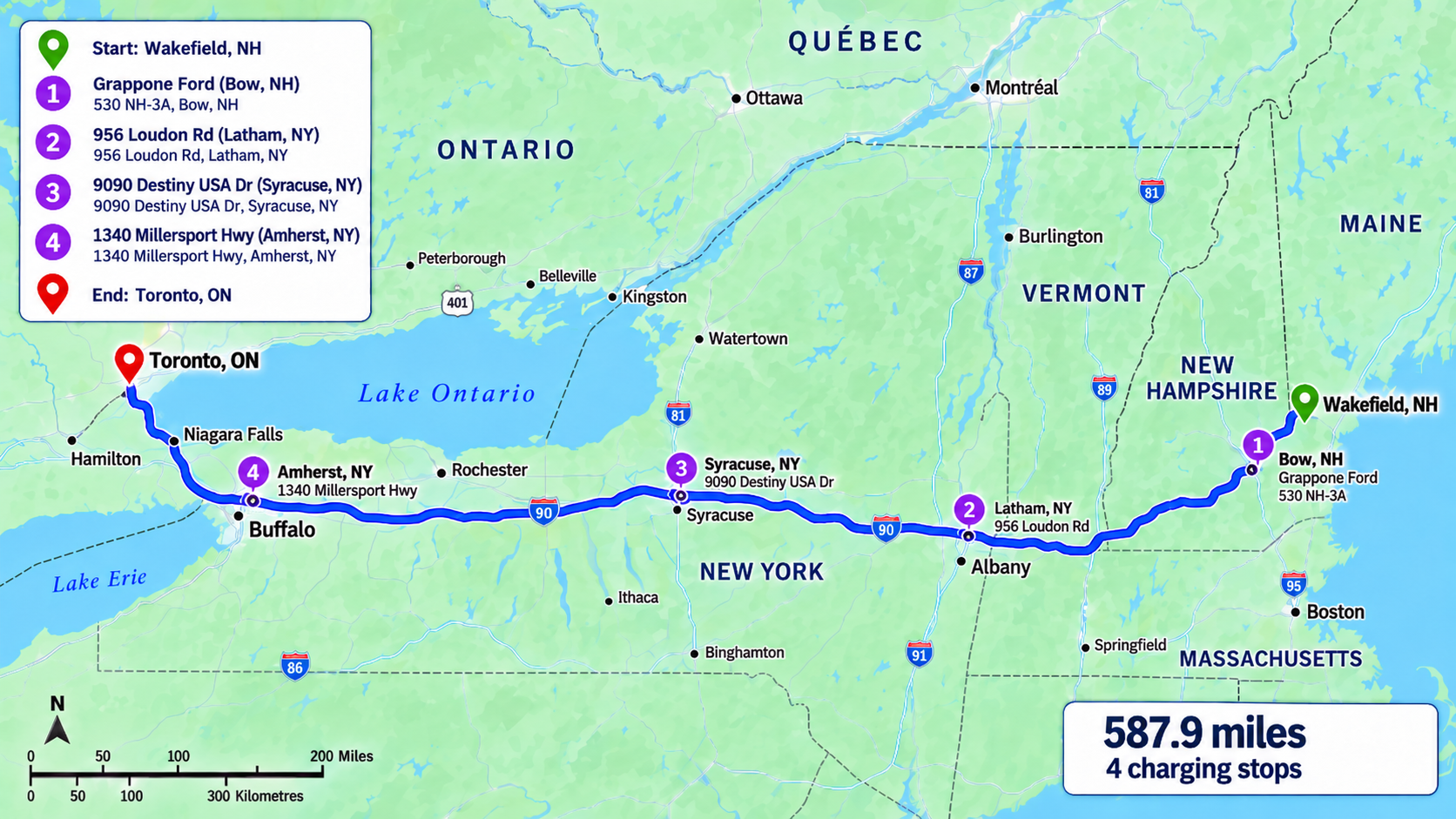
I arrived at my third charging stop, in Syracuse, New York, at 3:39pm with the battery at 30 per cent and an estimated range of 80 miles remaining. I had covered 143 miles, using 20 miles more range than the car had initially predicted, at an average efficiency of 2.8 miles per kWh (22 kWh/100 km). At motorway speeds, that translated into a potential full-battery range of only 254 miles.
This was a longer stop, as I had nearly another 150 miles to cover before reaching my next planned charging station. I left Syracuse at 4.24pm with the battery at 85 per cent and an estimated range of 234 miles. Let’s roll!
My fourth and final charging stop was near Buffalo, New York, close to the Canadian border. I arrived at 6:30pm, having covered 140 miles since leaving Syracuse. The battery was down to 30 per cent, with an estimated 80 miles of range remaining, although my average efficiency had improved slightly to three miles per kWh (21 kWh/100 km). Even so, I had used 14 miles more range than the car had predicted when I left Syracuse.
Onwards and upwards: I left Buffalo at 7pm with the battery at 78 per cent and an estimated range of 210 miles. That should be plenty, I thought, with only about 100 miles left to Toronto.

And it turned out to be. My strategy – charging until the estimated range was roughly twice the distance to the next stop – had paid off handsomely. I arrived in Toronto at 9pm with the battery at 43 per cent and 115 miles of range remaining. The Pony had again averaged three miles per kWh and, on that final stretch, I had effectively gained five miles against the car’s estimate. All was well in my world.
The journey from my home to Toronto through New York State covered 587.9 miles. Including the charging stops, it took 13 hours – compared with about ten and a half to 11 hours in a petrol-powered car. The difference was easily explained: four charging stops of roughly half an hour each added a little over two hours to the journey.
A little fun with chargers and charging apps
The return journey was almost as uneventful. For variety, I drove home through eastern Ontario and Quebec – a far better choice. Quebec’s roads were smooth, at least in summer, and its motorists remarkably polite (quelle surprise, right?), in stark contrast to New York State, where the roads were horrid and the drivers were assholes.
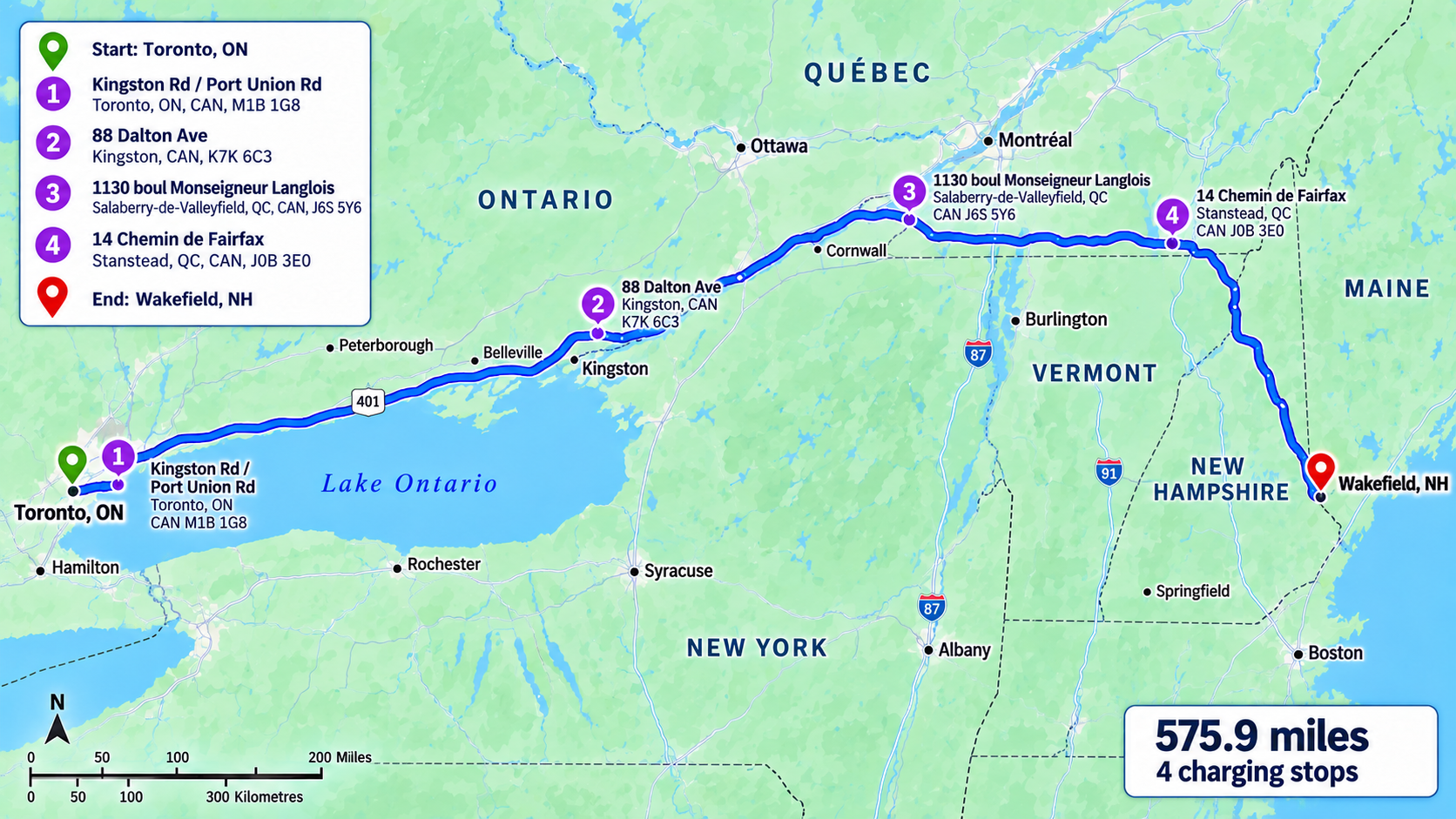
There was one incident in Quebec that began to worry me, although it all worked out in the end. My chosen charging station near Montreal, in the small town with the splendidly mouth-filling name of Salaberry-de-Valleyfield, had only two fast chargers – and both were occupied when I arrived. I found another station nearby, but it was outside Ford’s network, so I needed a separate app to use it.
However, when I tried to create an account, the app offered Puerto Rico as its only country option – and I was definitely not there. After a few choice swear words and a spike in blood pressure, I gave up and searched for a third charging station, all while wondering whether, with only 50 miles of range remaining, I would reach one where I could actually charge the Pony.
The route to the third station took me back past my original choice, where, fortunately, one of the chargers had become available. Panic over: the Pony received its much-needed charge, and all was right with the world again.
Most of the return journey from Toronto to Littleton, New Hampshire – which is almost home for me – was on highways, so my average efficiency hovered around 2.7 miles per kWh (23 kWh/100 km), considerably below my usual figure. But hey, I was in a hurry to get home. Having again planned four charging stops, the journey went smoothly.
I made my final stop in Stanstead, Quebec, just before crossing back into the United States. From there, I had an estimated range of 204 miles for the remaining 147-mile journey. I arrived home with the battery at 28 per cent and 70 miles of range remaining – helped largely by the fact that almost the entire stretch from Derby Line, Vermont, to my home was downhill.
Why EVs may be good for us
So, is it possible to take a 1,200-mile road trip in an electric vehicle? Damn right it is – particularly in the northeastern United States and densely populated Canadian provinces such as Ontario and Quebec. It is also worth noting that fast charging is somewhat cheaper in Canada than in the US. Then again, most things are.
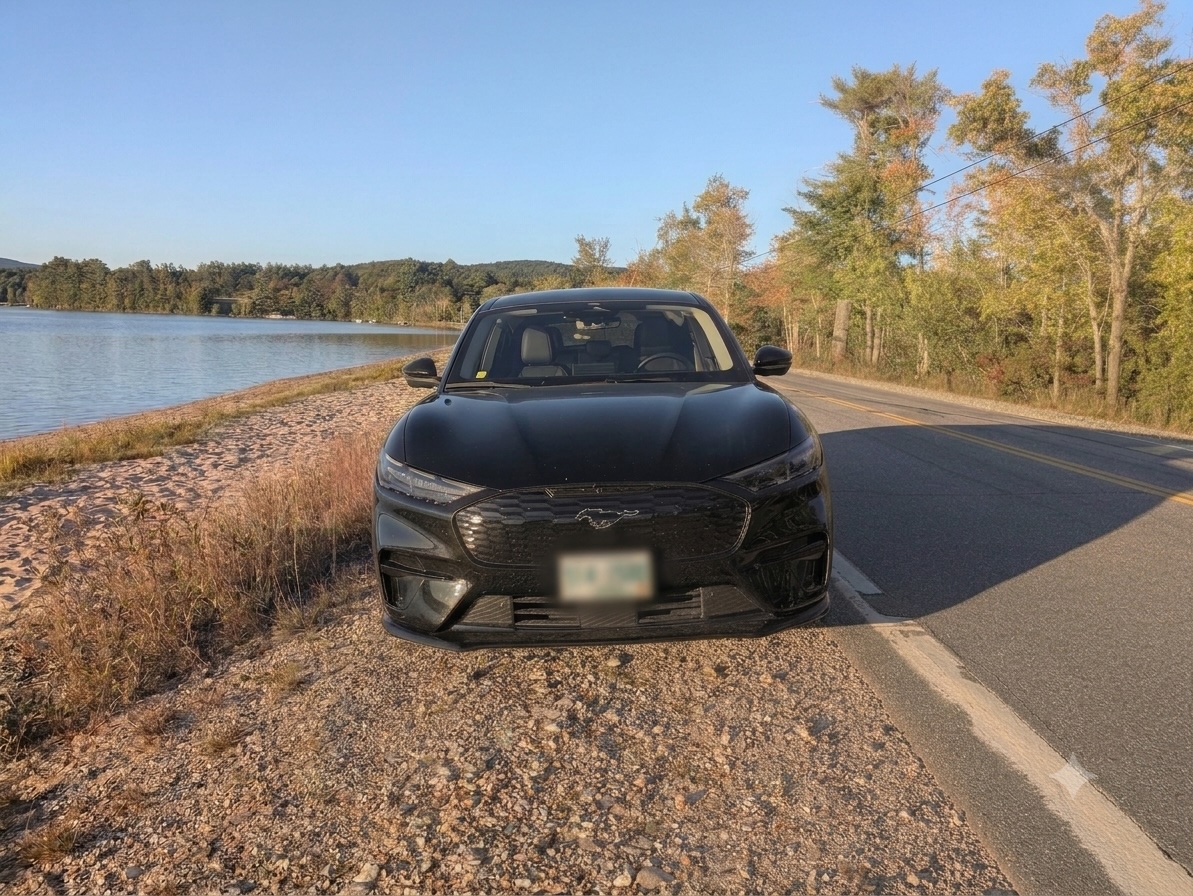
But the greatest benefit of taking a long road trip in an EV – particularly when travelling alone – is that you are forced to stop and recharge. That means taking a break, switching off from driving and doing something – literally anything – other than battling motorists on a busy highway. Those pauses may well have helped me stay sane during the long hours behind the wheel – and perhaps helped keep me safe and alive.
Of course, nothing stops you from taking a break when driving a petrol-powered car. True – but do you? Faced with a 600-mile journey, the instinct is to press on rather than stop for half an hour. You want to arrive sooner and rest at your destination, rather than pause along the way and improve your chances of arriving alive.
I therefore posit that EVs are good for us. Not only are they quiet, quick, agile and great fun to drive – as well as cheap to run compared with internal-combustion cars at today’s petrol prices – but they also force us to think about our own wellbeing on the road. I like that about them, too.