For Estonian businesses seeking growth beyond their small home market, Poland is beginning to look less like a familiar regional partner and more like a strategic frontier.
Estonian exports to Poland have surpassed €1bn for the first time, a symbolic threshold that says as much about Estonia’s search for scale as it does about Poland’s growing pull as one of Europe’s more dynamic markets.
At a business seminar on Poland held at Estonia’s foreign ministry on 9 April, diplomats, advisers and entrepreneurs painted a picture of a market that is large, increasingly attractive and full of promise – but also more demanding, more bureaucratic and less frictionless than many Estonian companies may be used to.
“Poland is the world’s 20th largest economy and an increasingly important market for Estonia,” Mariin Ratnik, the foreign ministry’s undersecretary, told the gathering. “Our exports to Poland have exceeded one billion euros for the first time, and Poland is now our sixth most important export market. Unlike many other countries, this growth has come specifically from goods and industry.”
A market too large to ignore
For a country of just 1.3 million people, Poland offers what Estonia cannot: depth. It is the EU’s sixth-largest economy, a logistics and manufacturing hub at the centre of continental trade routes, and a market of nearly 38 million consumers whose purchasing power has risen sharply in recent years.
A report commissioned by the Estonian foreign ministry argues that Poland combines macroeconomic resilience, a diversified industrial base and robust domestic demand in a way that should make it hard for Estonian exporters to ignore.
The figures are persuasive. Poland’s GDP is expected to grow by 3.7 per cent in 2025 and 3.4 per cent in 2026, outpacing the EU average. Real expenditure per capita rose by 28 per cent between 2019 and 2023, suggesting that the country’s consumers remain an increasingly important engine of demand.
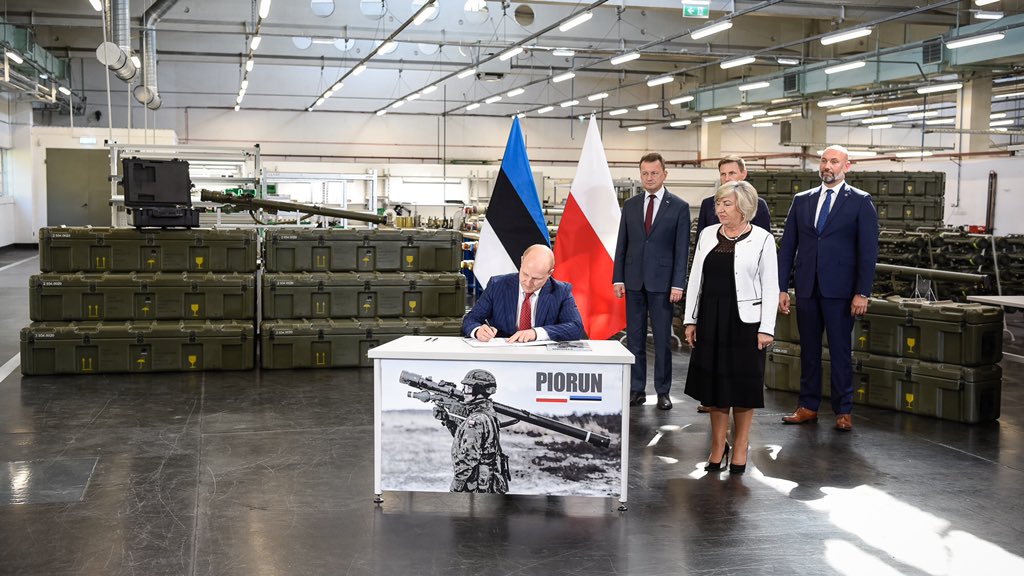
In a panel discussion, Estonia’s ambassador to Poland, Miko Haljas, and Anna Pełka, deputy head of mission at the Polish embassy in Tallinn, stressed that relations between the two countries are strong. Estonia and Poland are aligned on support for Ukraine and on European security, and that political convergence is spilling over into economic ties.
The most visible cooperation is currently in defence, a sector turbocharged across the region by Russia’s war against Ukraine and Europe’s broader rearmament. But speakers at the seminar argued that the real story is broader. Poland’s public sector is expected to invest heavily in transport, energy and defence in the coming years, opening the door to Estonian firms in digital systems, clean technologies and industrial niches.
Opportunity, but not on autopilot
Martti Rell, a partner at consultancy Civitta, presented an export strategy for Poland intended as a practical guide for Estonian companies. His message was encouraging, but not romantic.
“Poland is a large and highly competitive market with a growing consumer base,” he said. “Our analysis shows that it is generally advisable to start with a specific region.”
Entering Poland is not like entering a single compact Nordic market. It often means choosing a city, a region, a sectoral niche and a local network before trying to expand further.

Marcin Jozwiak / Unsplash.
According to the report, the strongest prospects for Estonian exporters lie in ICT, timber, fintech, clean technology and defence technology – sectors where Estonia has either proven competence, brand recognition or a plausible competitive edge. Food and beverages, education technology, maritime services and health technology also offer openings, though with fiercer local competition and less obvious advantage.
In food, the logic is particularly unforgiving. Mass-market competition is hard. Higher-value niches are more realistic.
That emphasis on niches, local credibility and patient execution was echoed by companies already operating in Poland.
Trust, presence and the long game
“Preparing for a meeting means there must always be biscuits on the table, and you need to be more patient,” said Markus Törnberg, head of the Polish market at Waybiller. “Poland is a large country and everything takes more time, but a successful pilot project can become your best ally and open doors in the Polish market.”
In Poland, several speakers suggested, relationships are built in person and trust still matters profoundly. Compared with Estonia, television and other offline advertising remain more influential. The understated, digital-first, efficiency-maximising habits of Estonian business culture do not always translate neatly.

For Tavex, the precious metals and financial services group, the experience has been broadly positive. Jüri Martin, a member of the management board, said the company now employs around 120 people in Poland. “Polish people are very conscientious, so cooperation and communication with the local team are generally straightforward,” he said.
Others stressed that a visible local footprint is essential. Tomaš Pozlevič, regional sales manager at Frankenburg Technologies, an Estonian defence firm, argued that credibility begins long before the first formal meeting. “If nothing about you or your company appears in Polish on Google, it does not build trust,” he said. LinkedIn, he added, can work well for finding contacts and setting up meetings – provided the approach is serious and offers real value.
Then there is the paperwork.
Growth, with paperwork attached
Milena Zaszewska-Topczewska, head of Julianus Inkasso Poland, offered the sharpest illustration of the administrative culture companies may encounter. Poland may have introduced digital systems for court submissions, she noted, but paper still has an almost theatrical afterlife. A document is submitted electronically, printed in court, then accompanied by another printed confirmation. What begins as one document can swiftly become two.
The anecdote drew laughs, but its message was clear. Poland may be growing fast, but it is not frictionless. Regulation, bureaucracy, language barriers and legislative complexity remain among the most commonly cited barriers for foreign businesses. Public procurement alone – worth around €61.6bn in 2023, or roughly 8 per cent of GDP – offers major opportunity, but also formal processes, heavy documentation and a system in which price still weighs heavily in tender decisions.

Tomasz Zielonka / Unsplash.
For Estonian companies, that means enthusiasm will have to be matched by stamina. Polish-language materials matter. So do local partners, local advisers and a willingness to adapt. Translated marketing copy, Zaszewska-Topczewska warned, often sounds foreign and fails to inspire confidence. Native execution counts.
Still, for Estonia, the broader direction is unmistakable. As growth becomes harder to find in nearby small markets, Poland is emerging as an increasingly logical destination: close enough to know, large enough to matter, and politically aligned at a moment when security and economics are becoming more tightly intertwined.
The seminar, organised by the foreign ministry in cooperation with Enterprise Estonia, ended with a familiar message from export advisers and diplomats: support is available, the groundwork has been mapped, and the moment is ripe.