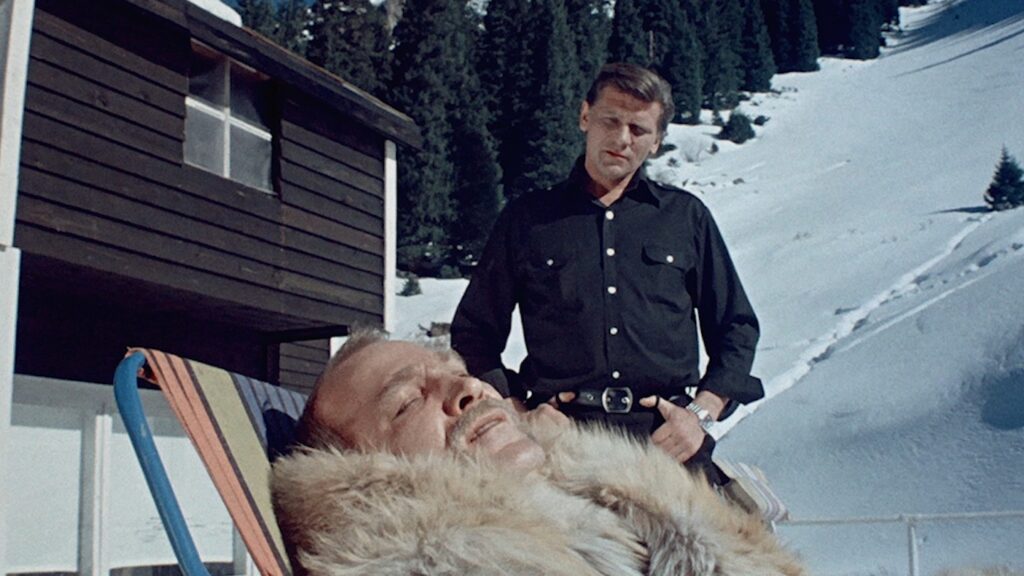
Grigori Kromanov’s 1979 cult science-fiction film Dead Mountaineer’s Hotel will screen at the Shanghai International Film Festival in June, bringing one of Estonia’s most distinctive Soviet-era films to Chinese audiences.
The film, known in Estonian as Hukkunud Alpinisti hotell, has been selected for the festival’s 4K Restoration programme, which presents notable restored works from world cinema. This year’s selection also includes restored versions of Miloš Forman’s One Flew Over the Cuckoo’s Nest, Martin Scorsese’s New York, New York, Alejandro González Iñárritu’s Amores Perros and David Fincher’s Panic Room.
The 28th Shanghai International Film Festival opens on 12 June and runs until 21 June. It is the only A-category film festival in China accredited by the International Federation of Film Producers Associations, FIAPF, and is regarded as one of Asia’s major film events.
A philosophical mystery in the mountains
Completed in 1979, Dead Mountaineer’s Hotel is based on the novel of the same name by Soviet science-fiction writers Arkady and Boris Strugatsky. Blending detective fiction, speculative philosophy and a coldly hypnotic visual style, the film follows Inspector Peter Glebsky, who arrives at a remote Alpine hotel after receiving an anonymous message. When an avalanche cuts off the hotel and a guest is found dead, what appears to be a conventional murder investigation begins to unravel into something stranger and more metaphysical.
“Dead Mountaineer’s Hotel” trailer.
Over the decades, the film has become a cult classic, admired for its eerie atmosphere, restrained performances, philosophical ambiguity and Sven Grünberg’s electronic-inflected score, one of the most memorable in Estonian cinema.
Its visual world was unusually ambitious for an Estonian film of the period. Interior scenes were shot in Tallinn, where a multi-storey hotel complex was built inside a newly completed tennis hall, while exterior scenes were filmed in the Tian Shan mountains in Kazakhstan, near the Shymbulak ski resort. For panoramic shots, an entire hotel structure was built in the mountains using timber transported from Estonia.
Restored for a new audience
The film was digitised by the Film Archive of the National Archives of Estonia and restored by its US distributor, Deaf Crocodile Films. The restored version had its world premiere in February at the Berlin International Film Festival, where it opened the Berlinale Classics programme.
Ahead of the Berlinale screening, the head of the Estonian Film Institute, Edith Sepp, said moments like these showed “how important it is to preserve and digitise film heritage and make it visible to the world”.
Sven Grünberg’s score for “Dead Mountaineer’s Hotel” is widely regarded as one of the most distinctive in Estonian cinema.
The Shanghai screening continues a remarkable international revival for Kromanov’s film, placing it alongside some of the best-known restored works in global cinema. For an Estonian film made under the Soviet studio system, and long sustained by cinephile admiration rather than commercial machinery, its return to major festival screens is a reminder that film heritage rarely stays still.
The film is preserved by the Film Archive of the National Archives of Estonia.