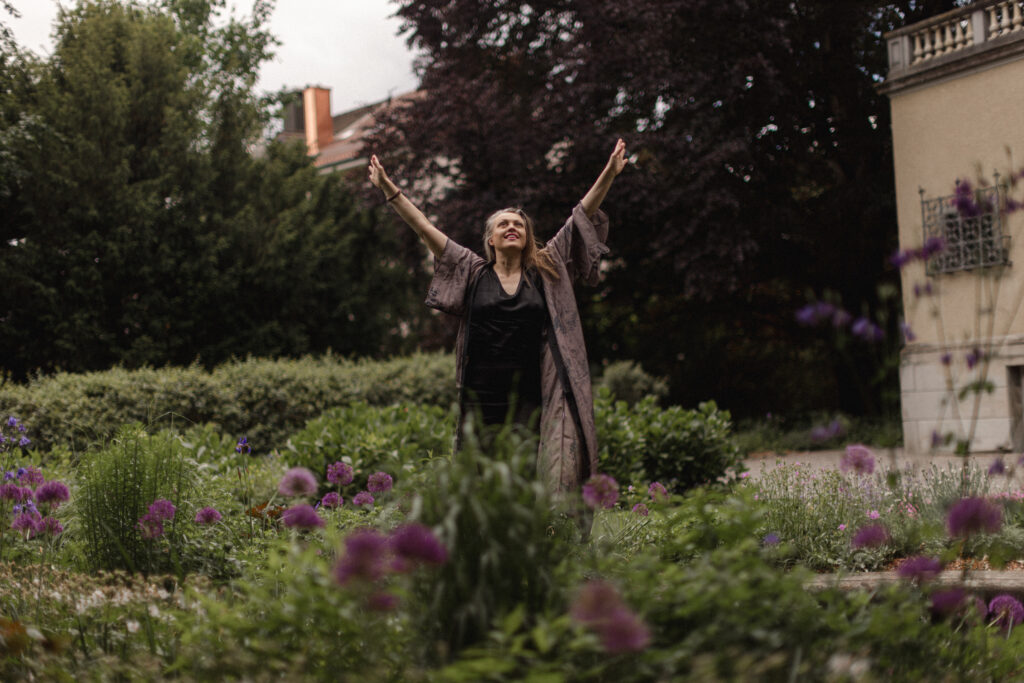
She was five when she joined the Baltic Way, too young to understand its politics but old enough to feel thousands of voices becoming one; now, with an album 25 years in the making, the Estonian-Swiss singer-songwriter talks to Estonian World about regilaul, silence and why music became her first home.
At five, Ingrid Lukas stood in the Baltic Way and felt thousands of people become one through song. Long before she understood the politics, she understood the power of a collective voice. Decades later, after a childhood move to Switzerland, profound loneliness and a period in which her own voice disappeared, music remains her route to freedom, belonging and home.
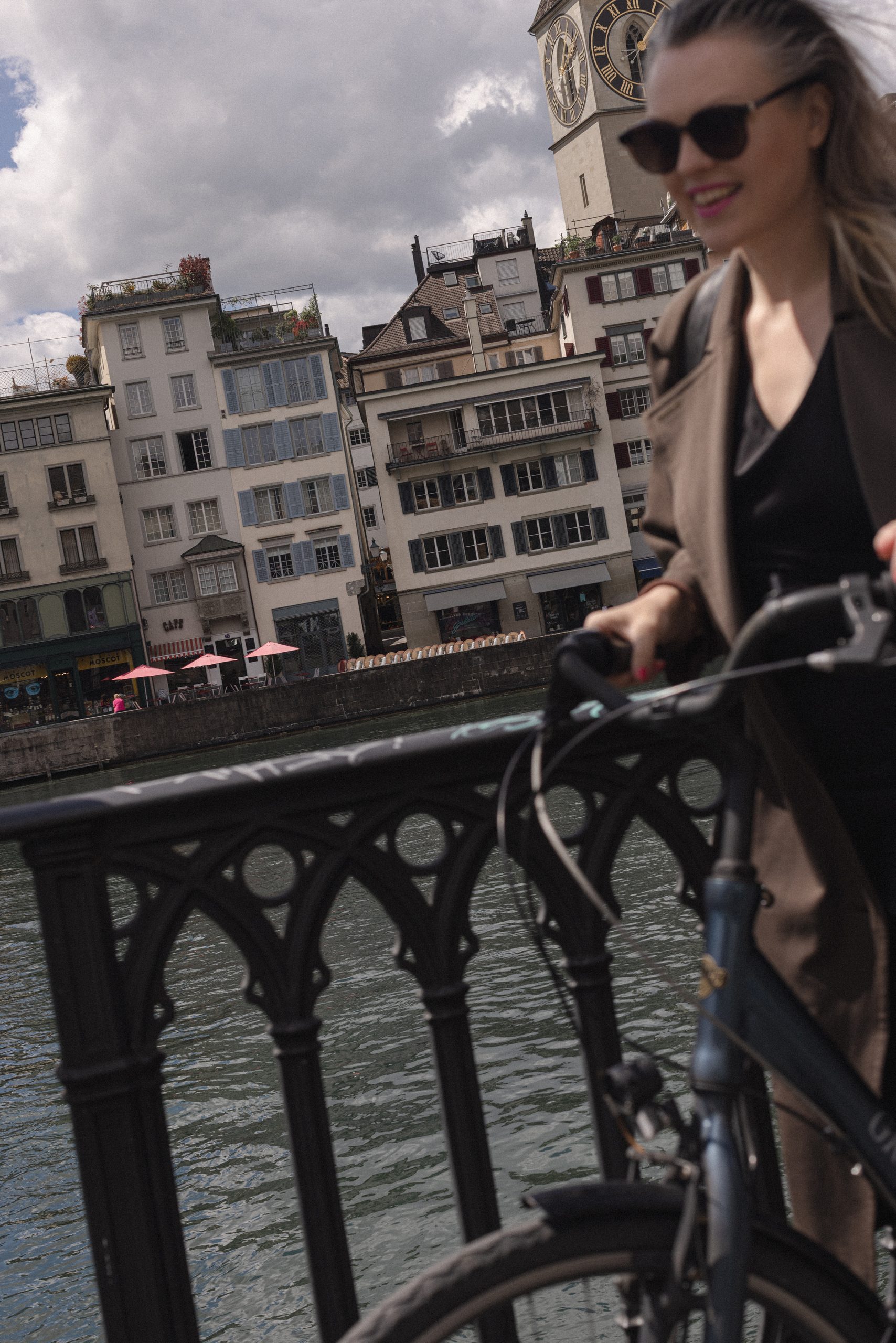
Born in Estonia in 1984, Lukas moved to Switzerland at the age of ten and went on to become a singer-songwriter, voice coach, pianist, bandleader and music therapist. She holds a master’s degree in jazz and popular singing from Zurich University of the Arts and a second master’s in music therapy from Berlin University of the Arts. Speaking to Estonian World at the Paradiesli café in Zurich, she reflects on her Estonian roots, the music inside silence and the new album that took her 25 years to write.
What did you have for breakfast today?
Music.
Most mornings, I wake at around six. Before I speak to anyone, look at my phone or have breakfast, I drink a glass of water and sit down at the piano.
The moments just after waking have always felt sacred to me. It is as if part of the soul is still travelling between worlds, not yet fully returned to everyday life. Everything feels softer, more open and more mysterious.
That is when I love to sing. While the water for my matcha is heating, I am often already improvising, recording melodies or writing songs. Some mornings, an entire piece arrives before breakfast.

You were five years old in 1989 when you took part in the Baltic Way. What do you actually remember from that day?
I was only five, so I do not remember the historical details. What I remember is a feeling. There was something in the air. You could sense it everywhere – a vibration, an excitement, as if something much bigger than all of us was about to happen.
We were at our summer house in Viimsi. My family stayed at home, but our neighbours, Vello and Helgi, were leaving to join the Baltic Way. I remember begging them, “Please take me with you.” And they did.
What happened next is difficult to put into words. Thousands of people stood together, holding hands and singing. As a child, I did not experience it politically. I experienced it as something deeply human and profoundly spiritual.
It felt as if something larger than ourselves was moving through us – not through one person, but through all of us together. For a brief moment, the boundaries disappeared. There was no separation. There was only this immense feeling of unity, freedom and belonging.
Looking back, I think that day shaped my life more than I realised at the time.
For me, singing has always been connected to freedom. When I sing, I feel free. And when people sing together, something extraordinary can happen. The individual steps aside and something greater begins to speak through the collective voice.
Even today, when I improvise at the piano or sing on stage, I sometimes encounter that same feeling again, especially when I invite the audience to sing with me. Suddenly, it is no longer about me. Something shifts. The room begins to breathe as one. Voices merge and, for a moment, we become part of something larger than ourselves. That feeling is very close to what I remember of the Baltic Way.
I sometimes wonder whether that day gave me a glimpse of what I would spend my life exploring – not the event itself, but the feeling it carried: unity, freedom, belonging and the mystery of what can happen when people sing together.

You moved to Switzerland at the age of ten. How did that happen?
It all started with a love story. My mother worked as a translator in Estonia in the early 1990s. One day, some Swiss businesspeople came to Estonia and she translated for them. That is where she met my stepfather.
A few years later, when I was ten, we moved from Estonia to Winterthur.
For a child, it was a huge change – a new language, a new culture and a completely different landscape. Estonia was still carrying traces of the Soviet era, while Switzerland felt almost like another world. And then there were the mountains.
Coming from a country whose highest peak is only 318 metres, standing before mountains 2,000 or 3,000 metres high felt unreal. My stepfather took us hiking almost every weekend and I loved it.
At the age of ten, I did not yet know that the move would shape my whole life. It taught me to live between cultures and languages and eventually inspired one of the central questions that still runs through my music today: what does it really mean to feel at home?

You left home at fifteen. That is very young to make such a decision. Where did that certainty come from?
It did not come from certainty. It came from longing.
For a long time, the question of home was a painful one for me. At fifteen, I left home because I was searching for something I could not yet name. I thought perhaps I would find it in Estonia, with my grandparents, my aunt, my father and my family. But everywhere I looked, something was missing. Eventually, I found myself living alone in Tallinn. I was sixteen and felt profoundly lonely.
At some point, my voice disappeared. I could still speak in one-to-one conversations, but in groups I became silent. Looking back, I think my soul was carrying more than it could hold.
What saved me was music.
Every day during breaks at school, I went down to the basement of Tallinna Saksa Gümnaasium, where there was a piano. I sang Let It Be over and over again and slowly began writing my own songs. Through music, I could express everything I could not put into words. That piano became my refuge – my first real home.
Over time, I began to understand that I was not searching for a place at all. I was searching for a place within myself. Music became that place. Through music, I slowly found my voice again. And by finding my voice, I found a sense of belonging.
Today, when I look back, it feels almost symbolic: a young girl searching for home lost her voice for a while. Through music, she found it again. Perhaps that is why I do what I do today.
As a singer-songwriter, music therapist and vocal coach, I have the privilege of accompanying others on their own journeys – not only to find their voice, but also to find the place within themselves that feels like home.

What similarities do you see between Estonia and Switzerland?
More than people might expect.
On the surface, Estonia and Switzerland look very different – one has the sea, the other the mountains. But underneath, I feel a similar spirit.
Both peoples are quiet, humble and deeply resilient. They do not make much noise about their strengths, yet both possess remarkable inner determination. There is a closeness to nature and a strong sense of independence that I recognise in both cultures. Perhaps that is why I have always felt at home in both countries. They taught me that strength does not have to be loud.

When you compose, what language do you think in: Estonian, German, English or simply sound?
Music.
Music is my first language. Estonian, German and English come later. When I compose, I do not really think in words. I think in sound, rhythm, melody and atmosphere. The words usually arrive afterwards.
Even when I listen to people, I am often less interested in what they say than in how they say it. I hear the melody behind the words, the pauses, the tone and the emotion. For me, every voice is already music. Maybe that is why I became a singer and voice coach. I am fascinated by the sound behind the words. Words tell a story, but sound tells the truth.

Is there something specifically Estonian in the way you hear and write music – a feeling, a rhythm or a kind of silence that you have never managed to translate into another language?
Yes, absolutely. There is a beautiful Estonian word: avarus. It means spaciousness, vastness, a sense of open sky. I think that lives deeply inside my music.
When I sing in Estonian, especially when I improvise or sing regilaul, I feel connected to something I cannot fully explain. It is as if another language begins to emerge – older than words, older than me.
There is something deeply Nordic in it: a certain silence, a particular relationship with nature, space and longing. I have never really found that feeling anywhere else. It is as if Estonia’s forests, winds, songs and silences continue to sing through me.

You have spoken about being deeply influenced by regilaul, the ancient Estonian runo-song tradition. What is it and what does it carry that you cannot find in other forms of music?
I am certainly not a regilaul specialist. For me, regilaul is a source of inspiration. On the surface, these songs are very simple: one voice sings and the others respond. But beneath that simplicity, I feel something vast. When I sing them, I feel connected to something much older than myself – to the voices of those who came before us, to the forests and the land and to the rhythms of work, grief, celebration and everyday life. It feels as though these songs carry an ancient memory.
I sometimes think of regilaul as a doorway – not into history, but into a deeper layer of being.
There is a song I sing called Vihmaloits (Rain Spell). Whenever I sing it, something shifts. My voice changes. It feels as though the song is singing me rather than the other way around. Maybe that is what touches me so deeply. When I enter that space, I no longer feel that I am performing a song. I feel more as though I am listening, receiving and allowing something ancient to move through me.
Arvo Pärt has been one of your major inspirations. Have you ever met him?
I have not met Arvo Pärt in person, but I have spoken to him on the telephone.
His music has accompanied me for more than twenty years and it still touches me deeply. When I first discovered it while studying in Zurich, it felt like opening a door to something sacred, something beyond words. At the same time, it connected me to my Estonian roots. His music is both deeply spiritual and deeply familiar.
What moves me most is the feeling that music can carry something greater than itself, that it can become a bridge between the visible and the invisible. That is what I am searching for in my own music too: a melody that feels like the most direct expression of the soul. Arvo Pärt shows me that such music is possible.

You have worked closely with Swiss pianist and composer Nik Bärtsch for many years. What is the most important thing he has taught you?
Presence.
Nik has been a mentor, friend and musical companion on my path for many years. We have shared music, conversations, the same studio building and countless cups of matcha.
What inspires me most is not something he taught me in words, but the way he lives. Nik returns to the practice every day. Again and again. Like an aikido master stepping onto the mat.
As an artist, I am often emotional, intuitive and sometimes chaotic. The path of music can be beautiful, but also incredibly difficult. There were moments when I wanted to give up. What Nik showed me is that enthusiasm is not enough. You also need presence, continuity and the willingness to begin again every morning.
His life reminds me that when you have found your elumeloodia – your life’s melody – you simply keep showing up for it.
Again and again.
No matter what.

Most musicians chase emotion. As a trained music therapist, you also understand exactly what music does to the human nervous system. Does that knowledge get in the way of the artist in you, or does it deepen the art?
For me, art and music therapy are not the same language, but they often speak to one another. As a music therapist, I listen for what a person needs. Sometimes we write songs together to express grief, reconnect with strength or simply find a way back to themselves. I have seen how a melody, a voice or even a single tone can open doors that words cannot.
As an artist, I listen to something different. I follow not only my own questions and longings, but also the questions of our time. Music allows me to explore what it means to be human, to belong, to connect and to find meaning in a changing world.
But the therapist in me is always quietly aware that music affects every level of our being – body, mind and soul – as well as our connection to others. Music can calm us, move us, connect us or bring us home to ourselves.
Perhaps the place where these two worlds meet most beautifully is Music of Silence, a project I created with the wonderful saxophonist and music therapist Diandra Russo. People lie down in churches, wrapped in blankets. We play. Then there is silence – deep silence – and then music again. Again and again, I witness how much people long for that. We live in a world full of noise, information and constant stimulation. Silence has become a rare and precious resource.
I have learnt that some of the deepest transformations happen beyond words. Sometimes people do not need answers – they simply need a space in which something inside them can soften, breathe, feel held and reconnect. Music can create that space.

In January, your voice appeared on a French electronic track being played in clubs across Europe after Angara sampled “We Are Touching Heaven”. From regilaul to a Berlin dance floor – what is it like to hear yourself there?
I love it.
For me, music has never been about genres. It has always been about connection.
One day, a melody is born quietly at my piano. Another day, it finds its way onto a dance floor in Berlin. That is magical.
What moves me most is the thought that a song can have many lives. It can comfort someone sitting alone at home. It can accompany someone through grief. It can also make people dance together at three o’clock in the morning. At its heart, it is still the same thing: people connecting through sound.
And honestly, I love seeing music travel further than I could ever take it myself.

Your new album is about home. Why now? What happened in your life to make this theme demand a work of its own?
This is the album that took me twenty-five years to write. For a long time, home was not a place of arrival for me. It was a question. A longing. A wound.
I was born in Estonia and grew up between worlds. For years, I searched for home in places, countries, relationships and achievements. But somehow, something was always missing. The only constant throughout my life was music. Music was my first home – the place to which I could return when everything else felt uncertain.
Over time, I realised that the search was never really about finding the right place. It was about finding a way to myself. About getting to know who I am. About making peace with my own story, my own path and my own voice.
And that took time. Today, I no longer feel that I am searching. Home has become something much bigger for me. It is music. It is nature. It is friendship. It is freedom. It is laughter. It is silence. It is the feeling of being fully present in my own life.
That is why this album is arriving now. Only after finding home within myself could I begin writing about it. And although the songs are deeply personal, they are not only about me. They are inspired by the hundreds of people I have met as a music therapist, teacher and vocal coach – people who are asking the same questions I once asked myself:
Who am I? What is my home? Who is my home? Where do I belong?
I hope these songs become an invitation – not to find answers, but to enter the conversation. Because perhaps home is not a destination at all. Perhaps home is the moment we stop searching and start listening to what has been quietly waiting inside us all along.

Estonian has the word kodumaa – homeland – but also kodu, which is more intimate. Which one is the album really about?
Definitely kodu.
This album is not really about a homeland. It is about belonging: the places, people, values and moments that allow us to feel at home within ourselves. Perhaps that is where kodumaa begins too – not on a map, but in the heart.
If someone is still searching for home, where would you invite them to begin?
I would begin with a very simple question:
What truly nourishes me?
Not what impresses other people. Not what I think I should want. But what genuinely makes me feel more alive, more connected and more myself.
I believe there is a quiet inner voice that knows. It knows which people are good for us, which places allow us to breathe, which paths belong to us and which do not.
For me, finding home was not about finding the right country, relationship or destination. It was about learning to listen to that voice. Maybe home begins the moment we stop searching everywhere else and start listening a little more deeply within.

If your music could carry one message to a young Estonian hearing it for the first time, what would it be?
Free your voice.
Not only your singing voice, but your true voice – the one that knows who you are beneath all the expectations, fears and doubts. Trust that quiet voice inside you. It may not always be loud, but it knows the way.
One last question: after all these years of searching, where does home find you now?
These days, home finds me in presence. In a song. In silence. In a shared moment. In the quiet feeling that, just for now, I am exactly where I am meant to be.