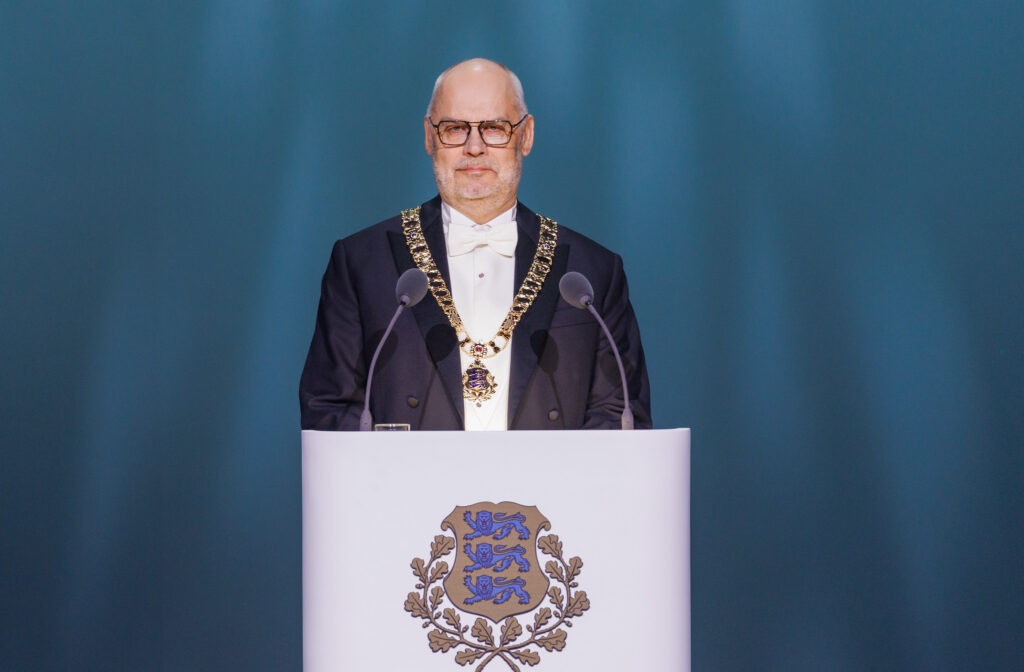
President Alar Karis’s Independence Day address was careful, responsible and clear in its loyalties; what it lacked was altitude – the kind of vision that lifts a nation beyond its anxieties.
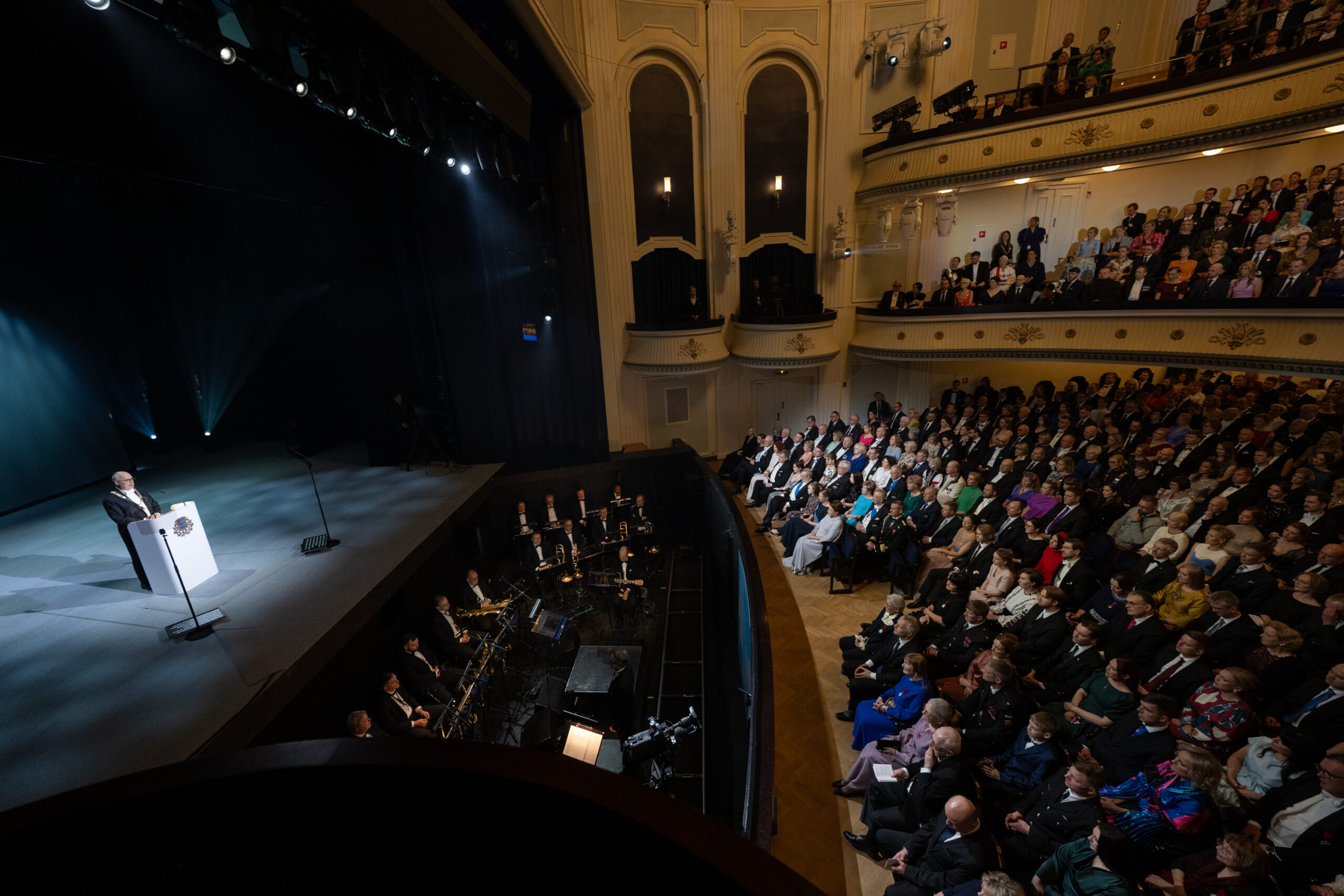
On the 108th anniversary of Estonia’s independence, President Alar Karis offered the nation a message of sobriety rather than splendour. His address at the Estonia Concert Hall, titled “The Future Depends on the Choices Each of Us Makes,” was thoughtful, conscientious and unmistakably serious. Yet for an occasion freighted with history and symbolism, it was curiously lacking in lift.
The speech opened charmingly enough, with the reflections of first-year pupils from Mustamäe Gymnasium: “I like Estonia the way it is… It’s nice to be in Estonia. I like how the sun shines in summer.” The innocence of those words was deftly contrasted with the burdens of adulthood. Estonia, the president implied, remains lovable – but its future is not guaranteed.
Karis, a scientist by training, spoke less as a tribune of destiny than as a diagnostician of systems. “If life stands still, then it doesn’t pause, but ends,” he warned, invoking biological adaptation as a metaphor for national survival. It was an elegant line, but also emblematic of the address: analytical rather than inspirational.
On foreign policy, there was welcome clarity. In an era when ambiguity can be mistaken for sophistication, Karis was direct. Ukraine, he said, represents “the real test of our values.” Recalling veterans who described their country as “Europe’s bulletproof vest,” he insisted that “Ukraine’s defences must not crumble.” Russia was named plainly as “the aggressor and initiator of this war.” Estonia’s commitments to NATO, the European Union and the transatlantic alliance were reaffirmed without qualification. In unsettled times, predictability has its virtues.
Yet it was not geopolitics that dominated the speech. The president reserved his greatest urgency for Estonia’s demographic decline. Last year, he noted, 9,092 children were born – the lowest figure in a century. “If we are unable to reverse the trend,” he cautioned, “then in just two generations’ time, there will be fewer than a million of us remaining.”
This was not mere rhetoric. Karis placed responsibility not on individual morality but on social architecture. Parents fear “the stability of their partnership, the retention of their employment, and the suitability of their living space.” Work culture leaves many burnt out “before they reach the phase of having kids.” Estonia, he argued, must become not only child-friendly but parent-friendly – a society that does not punish family life through labour-market insecurity or volatile policy.
The diagnosis was persuasive. Whether it amounted to a galvanising vision is another matter.
Perhaps the most arresting passages concerned loneliness. A “staggering 60% of Estonians” report feeling alone, he said, rising to 40% among non-ethnic Estonians who feel excluded from society. “When that inner warmth cools, outer frost can run amok,” he observed, recalling that nearly fifty people die of winter cold each year. Such images are rare in Independence Day oratory. They spoke to a deeper anxiety: that security is not solely a matter of tanks and treaties, but of social cohesion.
There were pointed, if discreet, admonitions for the political class. Laws should be transparent, constitutional and coherent; social division should not be stoked “for short-term gains.” Estonia, he suggested, risks overheating its public discourse: “We have overheated our precious sauna and are dazed by the brutal steam.” It was a characteristically Estonian metaphor, gently humorous but unmistakably sharp.
Education, in Karis’s telling, remains the ultimate safeguard. “Estonia’s future begins at the schoolhouse door,” he declared. His support for an artificial-intelligence education programme was framed not as a technological boast but as a matter of equity: without it, “the artificial-intelligence education gap would have exacerbated exponentially.” Here again, the president’s instinct was preventative rather than visionary – to avoid decline rather than to trumpet destiny.
Therein lies both the strength and the limitation of the address. Karis offered steadiness at a time of strategic uncertainty. He did not indulge in myth-making or rhetorical excess. His speech was grounded, measured and morally coherent.
But Independence Day is one of the few moments when a nation invites itself to dream in public. This was not a speech of soaring ambition; it was a speech of careful stewardship. It asked citizens to shoulder responsibility, to adapt, to remain calm and united. It did not sketch a bold horizon.
“Estonia’s story is not solely one of survival,” the president concluded. “It is a story of ambition, innovation, and freedom.” The sentiment is incontestable. Yet the ambition itself remained understated.
For a small country living under the shadow of war and demographic contraction, steadiness is no small gift. Whether steadiness alone will suffice is the question that lingers after the applause fades.
The full speech is available (in Estonian) on the President’s official website.