

As Estonians across the globe unite on 24 February to celebrate Independence Day, it is the perfect moment to reflect on the nation’s remarkable journey – from its first birth in freedom, through periods of loss, to its inspiring restoration.
A quest for independence
Beginning with the Northern Crusades, Estonia became a battleground for foreign powers from the 13th century onwards. Denmark, Germany, Russia, Sweden and Poland fought a succession of wars to control its strategic position as a gateway between East and West.
First conquered by the Danes and Germans in 1227, Estonia was subsequently ruled by Denmark, by Baltic German ecclesiastical states within the Holy Roman Empire, and by Sweden. After Sweden was defeated by Russia in the Great Northern War in 1710, Russian rule was imposed on Estonia. However, the legal system, the Lutheran Church, local and town government, and education remained largely German-influenced until the late 19th century – and in part until 1918.
The Estonian people never stopped dreaming of a state free from foreign domination. The estophile Enlightenment of 1750–1840 – when Baltic German scholars began documenting and promoting Estonian culture and language – helped pave the way for the Estonian national awakening in the mid-19th century, when Estonian arts, literature and a sense of identity began to flourish.

The 1917 Russian Revolution – and the wider instability in Russia – created an opportunity for Estonia to secure its independence. The drive for independence was propelled by the National Front, Estonia’s main ideological movement, which drew on US President Woodrow Wilson’s principle of self-determination.
On 8 April 1917, 40,000 Estonians held a demonstration in St Petersburg in support of Estonian self-government. The peaceful protest achieved its goal when, on 12 April, the Russian Provisional Government signed the Law on Estonian Autonomy, uniting the Livonian counties of Tartu, Võru, Viljandi, Pärnu and Saaremaa with Estonia. For the first time, an Estonian – Jaan Poska – was appointed provincial commissioner of Estonia.
A six-member Provisional National Council – the Maapäev – was formed. The Maapäev appointed a national executive that began to organise and modernise local government and educational institutions. Before it was forcibly dissolved by the Bolshevik authorities – and with a German invasion looming as the First World War raged on – the Maapäev took a decisive step towards sovereignty by declaring itself the supreme authority in Estonia on 15 November 1917.
Independence proclaimed
In February 1918, after the collapse of peace talks between Soviet Russia and the German Empire, mainland Estonia was occupied by German forces and the Bolsheviks retreated to Russia. In the brief window between the Red Army’s withdrawal and the arrival of the advancing Germans, the Salvation Committee of the Estonian National Council issued the Estonian Declaration of Independence on 23 February 1918.
The manifesto of Estonian independence was first read to the public from the balcony of the Endla Theatre in Pärnu at eight o’clock in the evening.
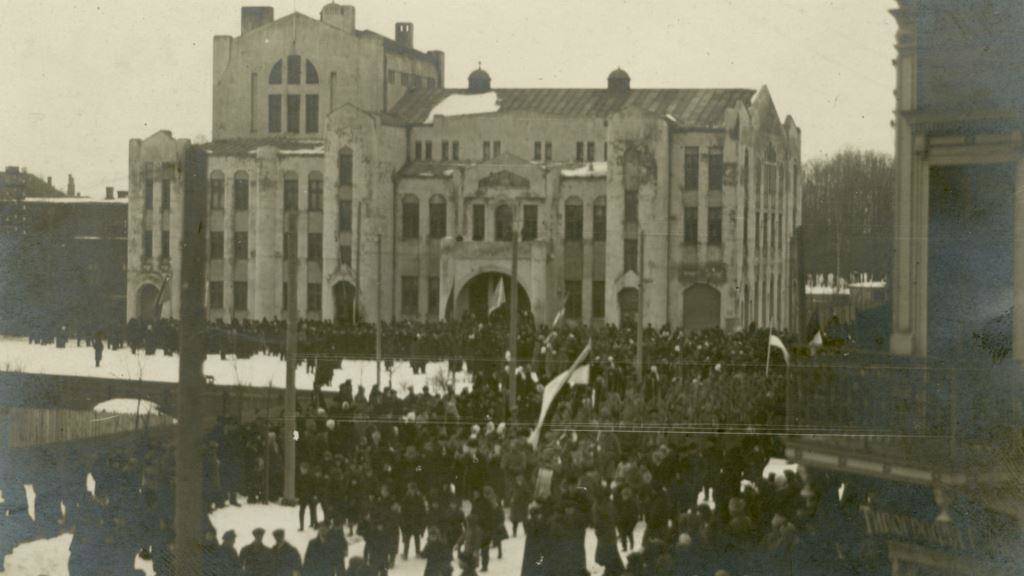
On 24 February 1918, Estonia was publicly proclaimed an independent and democratic republic.
This was not yet a happy ending, however. On 25 February, German troops entered Tallinn. The German authorities recognised neither the provisional government nor its claim to Estonia’s independence, dismissing them as a self-styled group usurping the sovereign rights of the German-Baltic nobility.
But as the First World War drew to its crushing end and Imperial Germany capitulated in November 1918, Germany formally handed political power in Estonia to the Estonian Provisional Government. The provisional government immediately called for voluntary mobilisation and began organising the Estonian Army, which initially consisted of a single division.
Russia attacks again
On 28 November 1918, the communist Red Army resumed its attack on Estonia, launching an offensive against units of the Estonian Defence League – made up in part of secondary school students – deployed to defend the border town of Narva. This marked the beginning of the Estonian War of Independence.
The Red Army attack came at an extremely difficult moment. The Estonian administration and defence forces had very little experience, and the army lacked sufficient weapons and equipment. Food and money were scarce, and the towns were in danger of starvation.

Although the majority of the population did not support Soviet Russia, confidence in the survival of Estonian statehood was low. Many did not believe Estonia could withstand the Red Army’s attacks.
The public’s fear was not unfounded. The Red Army captured Narva and opened a second front south of Lake Peipus. The Estonian government nevertheless decided to resist Russian aggression.
Estonia fights back
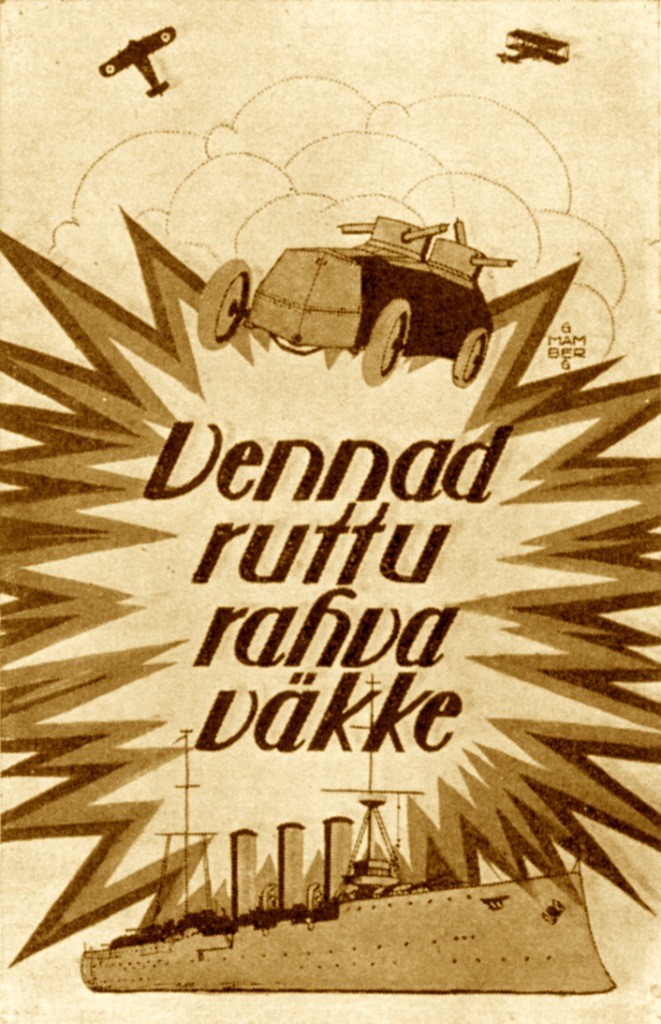
At the time, Estonian forces consisted of around 2,000 men with light weapons and about 14,500 poorly armed members of the Estonian Defence League. By the end of December, however, the young republic had managed to reorganise its armed forces and recruit a further 11,000 volunteers.
Estonia’s Baltic German minority, fearful of the communist Red Army, also came to Estonia’s aid by providing a sizeable volunteer militia force.
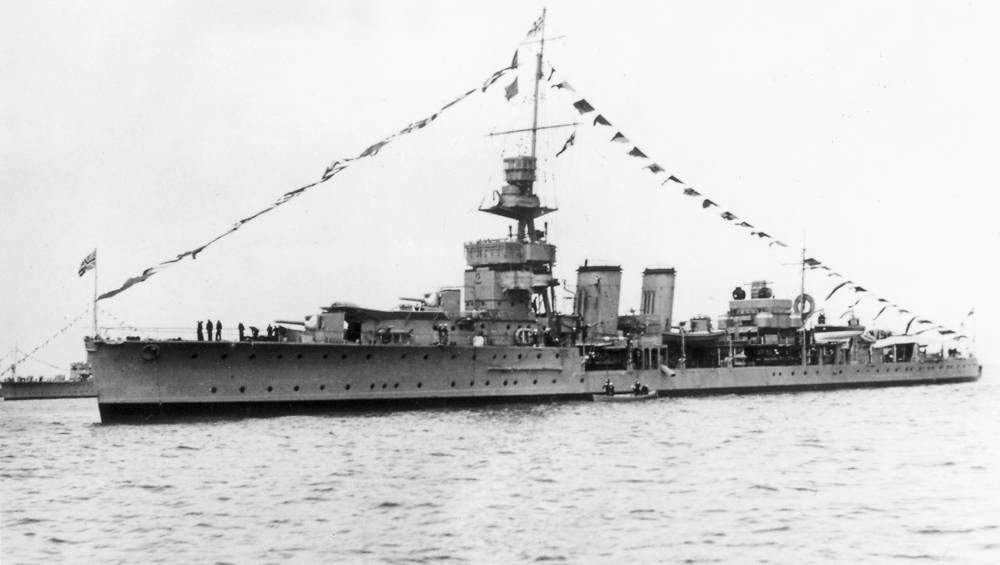
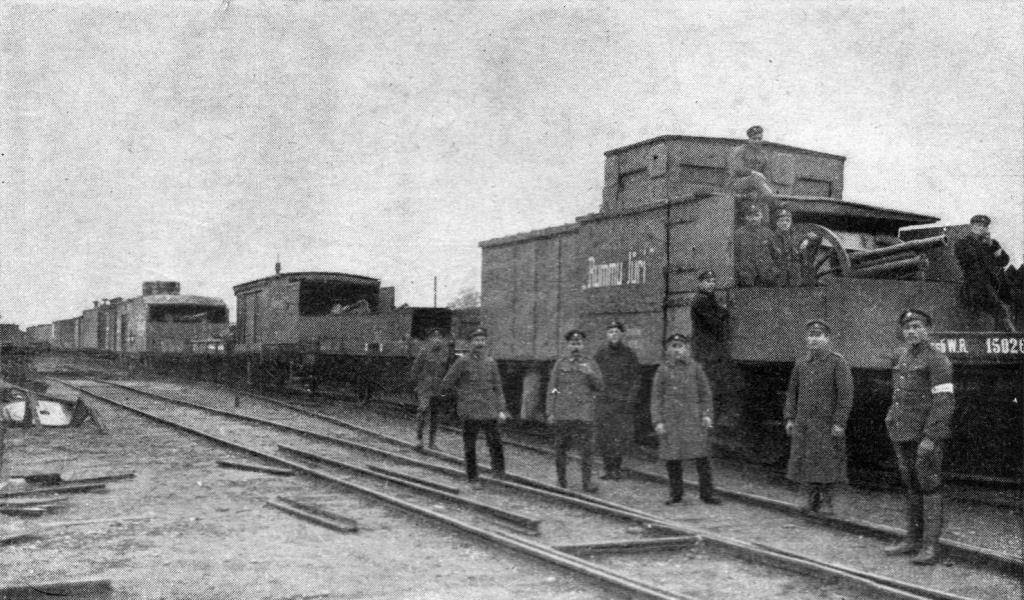
The country also managed to build three armoured trains and called for foreign assistance. In this hour of need, Estonia’s appeal was answered. When the Soviet army had advanced to within 34 kilometres (21 miles) of the Estonian capital in December 1918, a Royal Navy squadron arrived in Tallinn, bringing guns, food and fuel.
The squadron also captured two Russian destroyers – Spartak and Avtroil – and handed them over to Estonia, which renamed them Vambola and Lennuk. The United Kingdom remained Estonia’s main supplier of arms and equipment during the war.
Furthermore, in January 1919, Finnish volunteer units – numbering about 3,500 men – arrived in Estonia. Danish and Swedish volunteers also fought on the Estonian side.
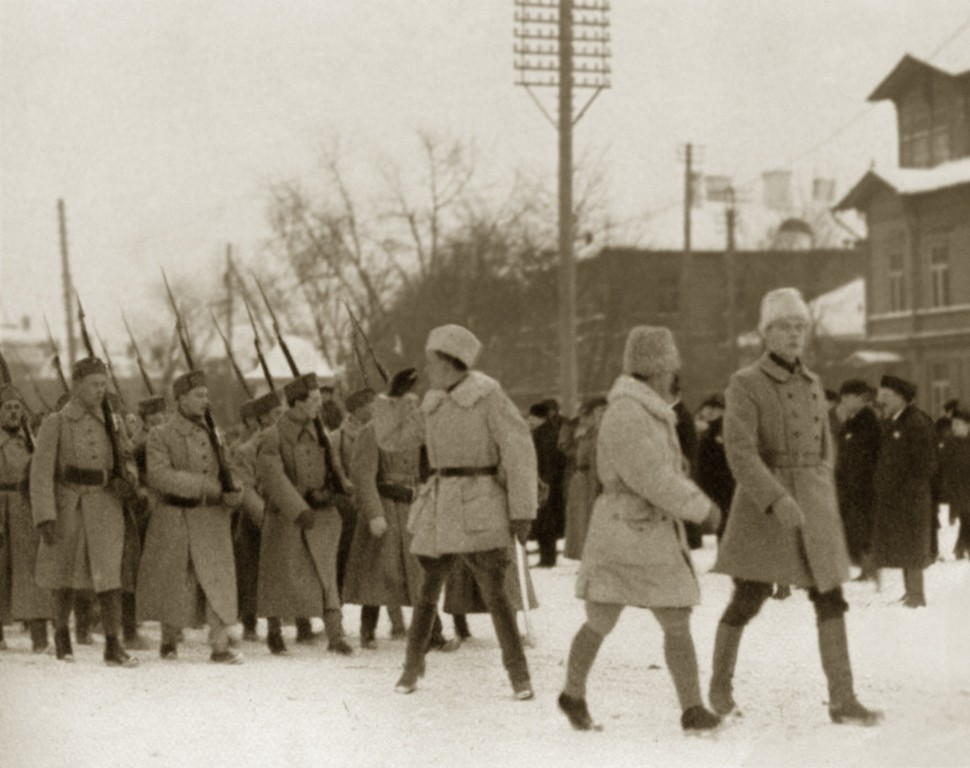
The strengthened Estonian Army, now totalling 13,000 men – with 5,700 on the front facing 8,000 Soviet soldiers – halted the advance of the 7th Red Army in early January 1919 and then launched a counter-offensive.

When the country celebrated its second Independence Day on 24 February 1919, Estonian forces numbered around 19,000 men, and Estonia had become the first country to repel the Soviet Union’s westward offensive.
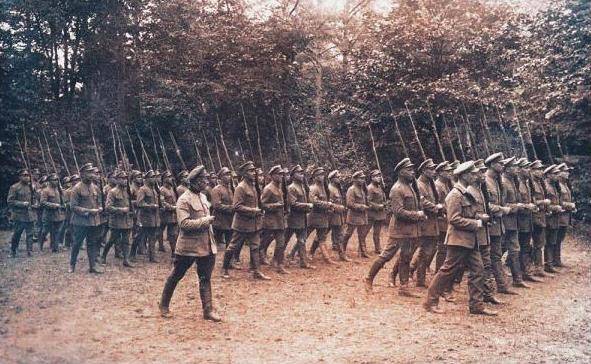
Driving the enemy out of the country strengthened confidence in the young republic and enabled another mobilisation, which proved crucial in sustaining the fight against a much larger Red Army – at one point during the war it committed around 80,000 soldiers against Estonia.

By May 1919, Estonian forces numbered around 75,000 men. The government and army command felt sufficiently confident to set a goal of pushing the front as far from Estonia’s borders as possible.
In May, Estonian troops launched an offensive towards Petrograd (St Petersburg) and captured a large territory east of Lake Peipus. Later in the year, however, they retreated in order to protect Estonia’s borders.
Independence ensured
The War of Independence continued with heavy fighting throughout 1919, as Soviet forces repeatedly attempted to regain lost ground. By the end of the year, the number of Estonian troops had risen to 90,000.
With Estonia’s determination to defend its independence proven on the one hand, and the still relatively fragile Soviet Russian government seeking to consolidate the Bolshevik revolution within Russia’s borders on the other, Russia officially offered Estonia a peace agreement.
Estonia emerged victorious, secured its borders and signed the Tartu Peace Treaty with Soviet Russia on 2 February 1920.

The country’s losses in the War of Independence were relatively small – around 2,300 killed and 14,000 wounded. Their sacrifice ensured that Estonia could enjoy freedom until 1940 – and then again from 1991 onwards.
Estonia in interwar period
After becoming an independent nation in 1918 and signing the Tartu Peace Treaty with Russia in 1920, Estonia promulgated its first constitution, establishing a parliamentary system. In 1921, the country became a member of the League of Nations.
With a political system in place, the new Estonian government immediately set about rebuilding. One of its first major acts was an extensive land reform, which distributed land to small farmers and veterans of the War of Independence. The large estates of the Baltic German nobility were expropriated, breaking its centuries-old power as a class.
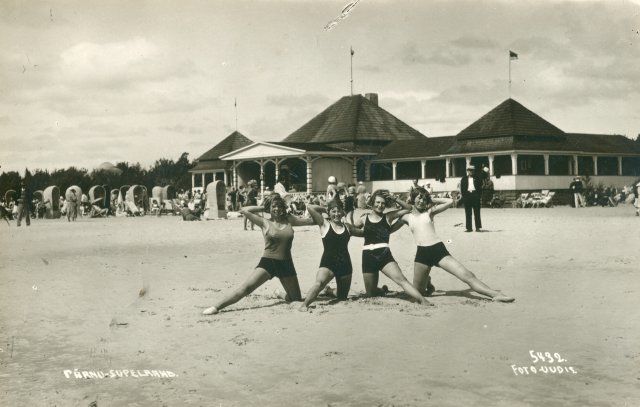
At first, agriculture dominated the country’s economy. Thanks to land reform, the number of small farms doubled to more than 125,000. Although many holdings were small, the expansion of landownership helped stimulate new production after the war.
Land reform, however, did not solve all of Estonia’s early problems. Estonian agriculture and industry – mainly textiles and machinery – had depended heavily on the Russian market. Independence and Soviet communism closed that outlet by 1924, and the economy had to reorient itself quickly towards the West, to which the country also owed significant war debts.
The economy began to grow again by the late 1920s, but suffered another setback during the Great Depression, which hit Estonia in 1931–34. By the late 1930s, however, the industrial sector was expanding once more, at an average annual rate of 14 per cent. By 1938, industry employed some 38,000 workers.
Independent Estonia’s early political system
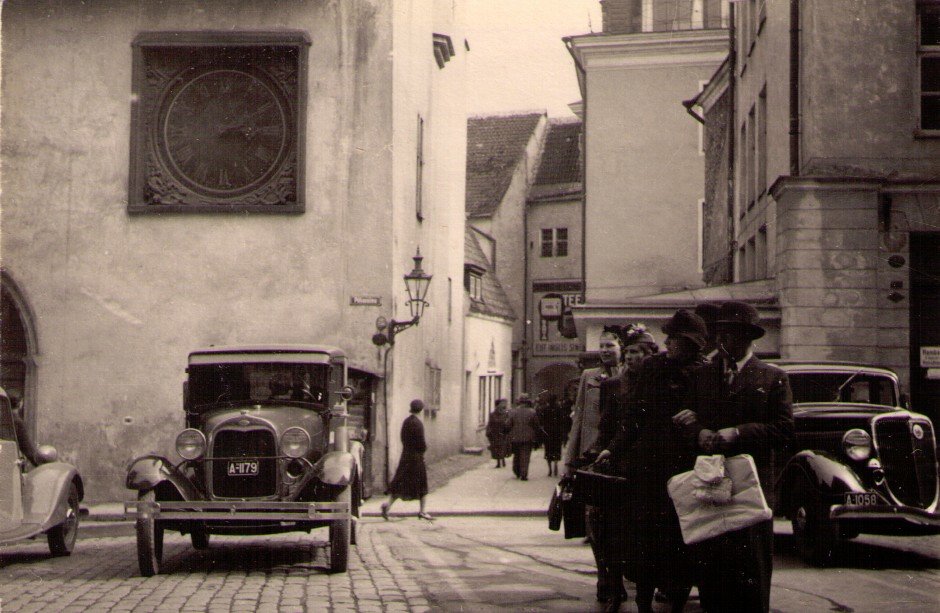
Independent Estonia’s early political system was characterised by instability and frequent changes of government. Political parties were fragmented and fairly evenly divided between the left and the right.
Under the first Estonian constitution, all major decisions taken by the prime minister and government required parliamentary approval. The Riigikogu (the State Assembly, Estonia’s parliament) could dismiss the government at any time without incurring sanctions. Consequently, between 1918 and 1933, a total of twenty-three governments held office (by comparison, in the 27 years after the restoration of independence in 1991, just 16 governments held office).
The country’s first major political challenge came in 1924, during an attempted communist takeover. In the depths of a nationwide economic crisis, leaders of the Estonian Communist Party – in close contact with Communist International figures in Moscow – believed the time was ripe for a workers’ revolution to mirror that of the Soviet Union.
On the morning of 1 December 1924, some 300 party activists moved to seize key government outposts in Tallinn, expecting workers in the capital to rise up behind them. The attempt soon failed, however, and the government quickly regained control.
In the aftermath, Estonian political unity received a significant boost, while the communists lost what credibility they had. Relations with the Soviet Union, which had helped instigate the coup, deteriorated sharply.
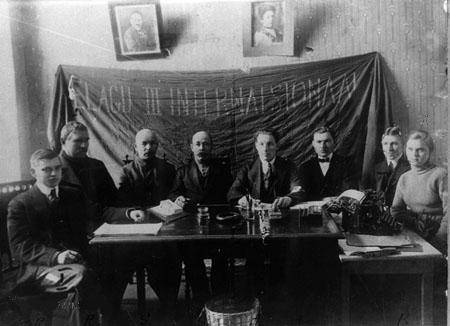
By the early 1930s, Estonia’s political system – still governed by an unbalanced constitution – again began to show signs of instability. As in many other European countries at the time, pressure was mounting for a stronger system of government. Several constitutional changes were proposed, the most radical of them put forward by the proto-fascist League of Independence War Veterans.
In a 1933 referendum, the league spearheaded the replacement of the parliamentary system with a presidential form of government and laid the groundwork for an April 1934 presidential election, which it expected to win. Alarmed by the prospect of a league victory and possible fascist rule, the caretaker prime minister, Konstantin Päts, organised a pre-emptive coup d’état on 12 March 1934.
In concert with the army, Päts began ruling by decree – a period that endured virtually without interruption until 1940. He suspended parliament and all political parties, disbanded the League of Independence War Veterans, and arrested several hundred of its leaders.
The subsequent “Era of Silence” was initially supported by most of Estonian political society. Once the threat from the league had been neutralised, however, calls for a return to parliamentary democracy resurfaced.
In 1936, Päts initiated a tentative liberalisation with the election of a constituent assembly and the adoption of a new constitution. During elections for a new parliament, however, political parties remained suspended, except for Päts’s own National Front, and civil liberties were restored only slowly. Päts was elected president by the new parliament in 1938.

Although the period of authoritarian rule from 1934 to 1940 was a low point for Estonian democracy, its severity would soon be eclipsed by the long Soviet era that followed.
The clouds over Estonia and its independence began to gather in August 1939, when Nazi Germany and the Soviet Union signed the Nazi–Soviet Non-Aggression Pact (also known as the Molotov–Ribbentrop Pact), dividing Eastern Europe into spheres of influence. Seeking to capitalise on its side of the deal, the Soviet Union soon began pressuring Estonia, Latvia and Lithuania into signing the Pact of Defence and Mutual Assistance, which allowed Moscow to station 25,000 troops in Estonia.
President Päts, in failing health and with little outside support, acceded to every Soviet demand. In June 1940, Soviet forces fully occupied the country, alleging that Estonia had “violated” the terms of the mutual assistance treaty.
Through rapid political manoeuvring, Joseph Stalin’s regime then forced the installation of a pro-Soviet government and called new parliamentary elections in July. The Estonian Communist Party – which had only recently re-emerged from underground and had fewer than 150 members – organised the sole list of candidates permitted to stand. Päts and other Estonian political leaders, meanwhile, were quietly deported to the Soviet Union or murdered.

With the country occupied and under total control, the communists’ “official” electoral victory on 17–18 July, with 92.8 per cent of the vote, was merely window dressing. On 21 July, the new parliament declared Estonia a Soviet republic and “requested” admission to the Soviet Union.
In Moscow, the Supreme Soviet granted the request on 6 August 1940. Independent Estonia was finished. After a brief German occupation from 1941 to 1944 – and failed attempts to restore Estonia’s independence – the Soviet Union occupied the country again; that occupation lasted until 1991.
The crisis in the Soviet Union opens a window of opportunity for Estonia
By the mid-1980s, the Soviet Union’s economy was in a critical state, largely due to its technological lag behind the West, the inefficiencies of the socialist planned economy rooted in extensive production, and the prioritisation of military industries. In the arms race with its principal adversary, the United States, the Soviet Union emerged the loser, having exhausted its potential.
Soviet exports of oil and gas suffered badly after fuel prices fell on the world market. At the same time, the Soviet Union became increasingly dependent on imported grain, as domestic production could not meet demand. Growing shortages of food and basic necessities (footwear, clothing, etc.), combined with rising prices, fuelled bitter resentment among the population.

Soviet foreign policy had also reached a dead end. For decades it had been expansionist, seeking to extend Soviet power across the world. The war in Afghanistan, launched in 1979, proved far more complex than initially anticipated, creating diplomatic difficulties and placing further strain on the country’s economy.
The Soviet leadership did not publicly acknowledge the crisis. As a result, many people – including most Estonians – were initially wary of Mikhail Gorbachev, the new leader of the Soviet Union, who launched his reformist policies in 1985. The keywords glasnost and perestroika (openness and reconstruction) seemed like empty slogans, and it was unclear what reforms and changes the new Soviet leader was actually pursuing.
The Soviet Union’s last leader, Mikhail Gorbachev, visited Soviet-occupied Estonia in 1987.
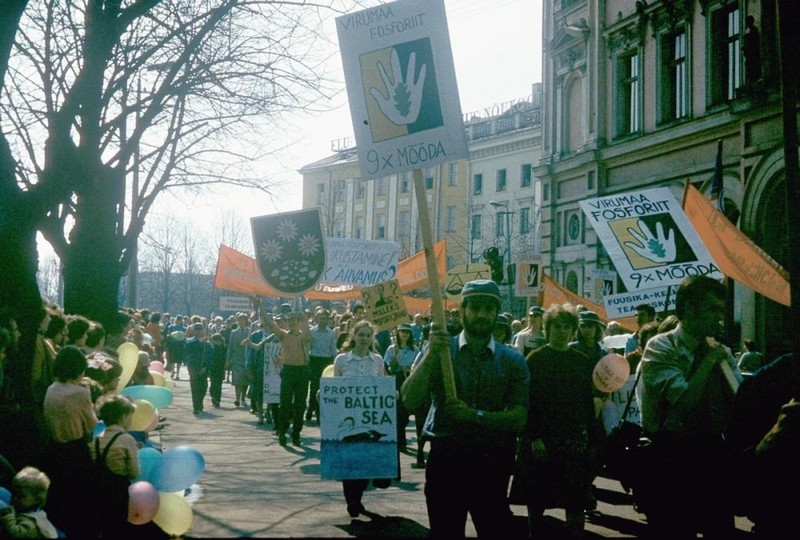
The first signs of radical change in Estonian society emerged in the spring of 1987, when Soviet plans to establish phosphorite mines in northern Estonia were revealed. This unleashed an extensive protest campaign – the “phosphorite war”. It also marked the start of Estonia’s drive to restore independence, as environmental concerns were soon joined by political demands.
In August 1987, the Estonian Group for the Publication of the Molotov–Ribbentrop Pact was founded (Estonian abbreviation: MRP–AEG). The group organised a mass meeting in Hirvepark in Tallinn later that month, where people demanded that the secret protocols of the 1939 pact be made public. The gathering was not forcibly dispersed, as it would have been in earlier years, which showed that civil rights had expanded and the regime had softened – the authorities even granted permission for the demonstration to go ahead.
The Estonian society awakens
Estonian society became politically active in 1988. A joint plenum of the creative unions – writers, artists, architects, and theatre and film professionals – focused on Estonian national culture and the threat of intensifying Russification, and voiced dissatisfaction with the actions of the Soviet Estonian leadership.
In mid-April, the Estonian Popular Front in Support of Perestroika was founded. This moderate – but clearly reform-minded – movement sought to make the Soviet Union more democratic and demanded political and economic autonomy for Estonia within the Soviet Union. The Popular Front’s moderate aims were enthusiastically supported by the Estonian population, and it quickly became a powerful mass organisation.
In early summer of the same year, a series of concerts and communal singing took place – soon developing into a large-scale popular movement that later became known as the Singing Revolution.
Alongside this moderate course, a more radical national movement emerged in 1988, explicitly aimed at restoring Estonia’s independence. The Estonian Heritage Society, established at the end of 1987, used thoroughly un-Soviet rhetoric. In August 1988, the first Estonian political party was founded – the Estonian National Independence Party (Estonian abbreviation: ERSP). Its core membership came from MRP–AEG.
In the summer, the Supreme Soviet of Estonia once again adopted the blue–black–white flag of the Republic of Estonia as the Estonian national flag.
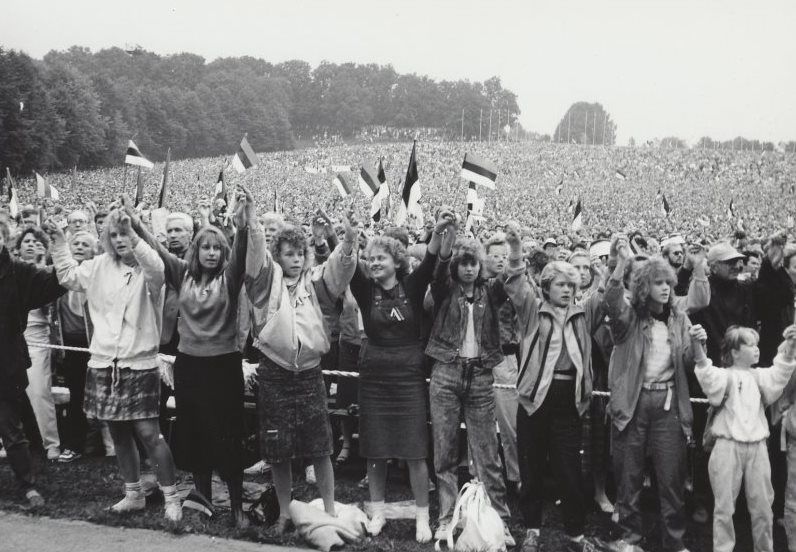
On 16 November 1988, the Estonian Supreme Soviet passed the Declaration of Sovereignty, which affirmed the supremacy of laws passed by the Soviet in the Estonian SSR. The document also stated that relations between the Soviet Union’s central authorities and a Union republic must be based on an agreement establishing the rights and duties of both sides, reached through negotiations. Moscow declared the declaration null and void, but was unable to halt the process of restoring independence.
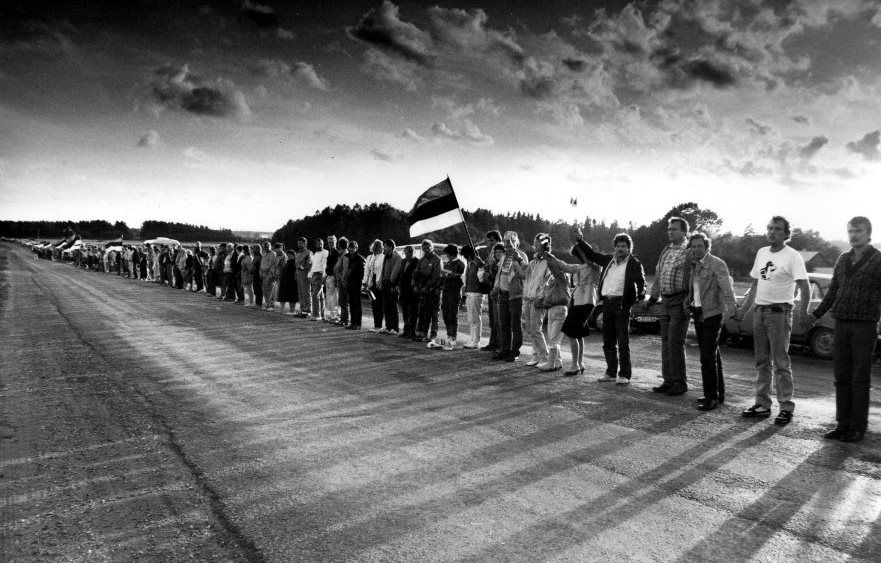
A special mass initiative by the pro-independence forces in the Baltic countries was the Baltic Chain, which attracted keen interest in the foreign press. On 23 August 1989 – the 50th anniversary of the signing of the Molotov–Ribbentrop Pact – around two million people formed a human chain from Tallinn via Riga to Vilnius, powerfully demonstrating their desire for independence.
Estonia regains its independence
In the spring of 1990, the Supreme Soviet of the Estonian SSR declared the authority of the Soviet Union in Estonia illegal. A transition period was announced which, in cooperation with the Estonian Congress, would lead to the restoration of the Republic of Estonia. In May, the name “Estonian SSR” was abolished and replaced by the “Republic of Estonia”.
However, independence had not yet been achieved. The Soviet Union still regarded Estonia and the other Baltic republics as Union republics subordinated to Moscow, and was prepared to use extreme force to maintain its authority – as seen in the violent events of January 1991 in Vilnius and Riga.
In both capitals, Soviet special forces attempted to seize media centres controlled by the national movements, and dozens of people were killed. Estonia was spared violence, apart from the attack on the Ikla border control point by Soviet special militia units in June 1991.

Finally, Estonia took advantage of the attempted coup d’état (the “August putsch”) in Moscow in August 1991. On 20 August 1991, the Estonian Supreme Soviet – in agreement with the Estonian Committee (the executive body of the Estonian Congress) – proclaimed Estonian independence, thereby restoring the Republic of Estonia, which had been legally established in 1918 and illegally occupied in 1940 by the Soviet Union.
This decision was quickly followed by the restoration of diplomatic relations and recognition of the Republic of Estonia by many countries, including Russia and the Soviet Union – which ceased to exist four months later.
The Republic of Estonia was restored on the basis of legal continuity – first established on 24 February 1918 – which is why the country celebrates its Independence Day on that date.
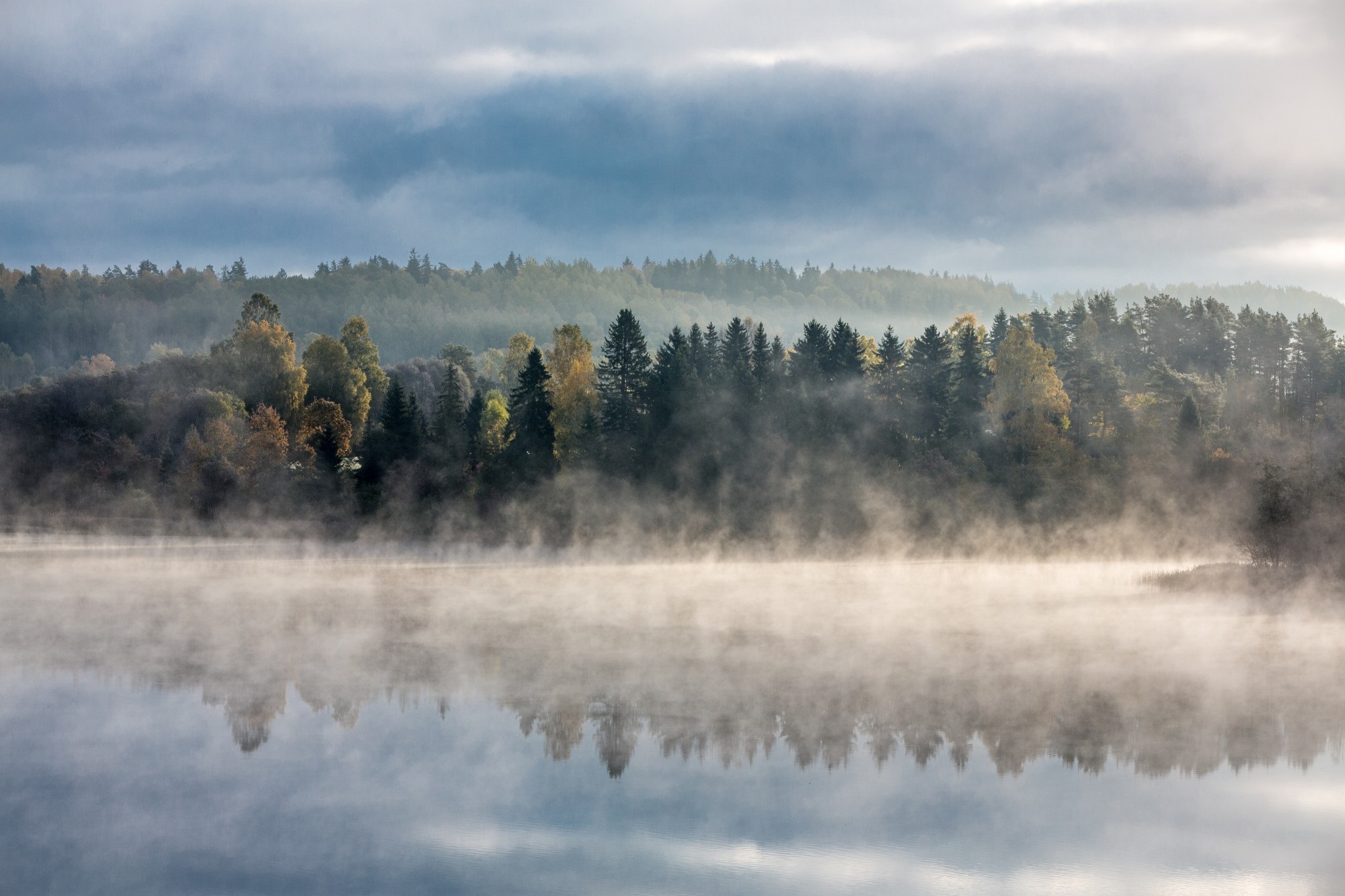
Since restoring its independence, Estonia has introduced wide-ranging reforms, joined the EU and NATO, and is among a small group of countries closest to becoming a fully fledged digital society. In many respects, the country is punching above its weight internationally. Over the past 34 years, it has shown that it can thrive as an independent state.
* This article was originally published on 24 February 2015 and lightly amended on 24 February 2026.


Happy Independence Day! Stay alert!
Well put together history lesson. Tänan! Long live Estonia!
Thank you for a very much needed over-view of the history of our tiny nation. So Proud to be Estonian.
I’m so impressed. I had overlooked this rich history.Thanks for sharing.
Happy birthday :* my dear and a big sweet estonia , my sisters , brothers and childrens .)
Palju õnne, julgustav ajalugu
Happy Independence day from Finland! Total bros!
Wish you a very Happy Independent Day Estonia
The Estonian history is partly quite similar as Finland’s. Wehave our Independance Day on Dec.6th since 1917 thus it’ll be 100 years this year. Before the 1917 Russian revolution the country belonged to Sweden until 1809 and then to Russia. Being a country near the Big Bear bot Estonia and Finland have had their bad times with the neighbour and also good times together against the enemy. Hopefully we’ll have peace all over the world – some day. The Finnish and Estonian languages are quite similar though they understand us better than we do -they used to watch Finnish TV before 1991 !
Very concise and well written. Lets hope Estonia has a bright future.
You have forgot the war against Baltic-German Landeswehr:
“The war against the Baltische Landeswehr broke out on the southern front in Latvia on 5 June 1919. The Latvian democrats led by Kārlis Ulmanis had declared independence like in Estonia, but were soon pushed back to Liepāja by Soviet forces, where the German VI Reserve Corps finally stopped their advance. This German force, led by general Rüdiger von der Goltz, consisted of the Baltische Landeswehr formed from Baltic Germans, the Guards Reserve Division of former Imperial German Army soldiers who had stayed in Latvia, and the Freikorps Iron Division of volunteers motivated by prospects of acquiring properties in the Baltics.[26] This was possible because the terms of their armistice with the Western Allies obliged the Germans to maintain their armies in the East to counter the Bolshevist threat. The VI Reserve Corps also included the 1st Independent Latvian Battalion led by Oskars Kalpaks, which consisted of ethnic Latvians loyal to the Provisional Government of Latvia.[1]
The Germans disrupted the organization of Latvian national forces, and on 16 April 1919 the Provisional Government was toppled and replaced with the pro-German puppet Provisional Government of Latvia led by Andrievs Niedra.[27][28] Ulmanis took refuge aboard the steamship “Saratow” under Entente protection. The VI Reserve Corps pushed the Soviets back, capturing Riga on 23 May, continued to advance northwards, and demanded that the Estonian Army ended its occupation of parts of northern Latvia. The real intent of the VI Reserve Corps was to annex Estonia into a German-dominated puppet state.
On 3 June, Estonian General Laidoner issued an ultimatum demanding that German forces must pull back southwards, leaving the broad gauge railway between Ieriķi and Gulbene under Estonian control. When Estonian armoured trains moved out on 5 June to check compliance with this demand, the Baltische Landeswehr attacked them, unsuccessfully.[29] The following day, the Baltische Landeswehr captured Cēsis. On 8 June, an Estonian counterattack was repelled. First clashes demonstrated that the VI Reserve Corps was stronger and better equipped than the Soviets. On 10 June, with Entente mediation, a ceasefire was made. Despite the Entente demand for the German force to pull behind the line demanded by the Estonians, von der Goltz refused and demanded Estonian withdrawal from Latvia, threatening to continue fighting. On 19 June, fighting resumed with an assault of the Iron Division on positions of the Estonian 3rd Division near Limbaži and Straupe, starting the Battle of Cēsis. At that time, the 3rd Estonian Division, including the 2nd Latvian Cēsis regiment under Colonel Krišjānis Berķis, had 5990 infantry and 125 cavalry. Intensive German attacks on Estonian positions continued up to 22 June, without achieving a breakthrough. On 23 June, the Estonian 3rd Division counterattacked, recapturing Cēsis. The anniversary of the Battle of Cēsis (Võnnu lahing in Estonian) is celebrated in Estonia as the Victory Day.”
https://en.wikipedia.org/wiki/Estonian_War_of_Independence
You are missing the Landeswehr story – when Estonia battled Baltic German forces.