Ülle Madise, Estonia’s chancellor of justice, is being discussed as a possible consensus candidate after president Alar Karis ruled out seeking a second term.
Madise, one of the country’s most respected constitutional voices, has emerged as a leading contender to become Estonia’s next president.
Her name is being put forward as parties begin testing possible candidates after president Alar Karis announced that he would not seek a second term. Although the proposal has so far been made publicly by the Social Democratic Party, Madise is being presented less as a party candidate than as a possible consensus figure capable of attracting support across the Estonian parliament.
A possible consensus candidate
Tanel Kiik, the deputy chairman of the Social Democratic Party, said the party leadership had discussed several names and concluded that Madise had the strongest chance of securing the votes needed in parliament.
“In our assessment, Ülle Madise has the greatest likelihood of receiving the necessary support in the Riigikogu,” Kiik said.
Under Estonia’s indirect electoral system, the president is first elected by the 101-member parliament. A successful candidate needs the support of two-thirds of MPs, or 68 votes. If parliament fails to elect a president after several rounds, the decision moves to an electoral body.
The presidential election is due to begin in parliament on 2 September, with further parliament rounds expected on 3 September if no candidate secures the required majority.
If elected, Madise would become Estonia’s second female president. The first was Kersti Kaljulaid, who served from 2016 to 2021.
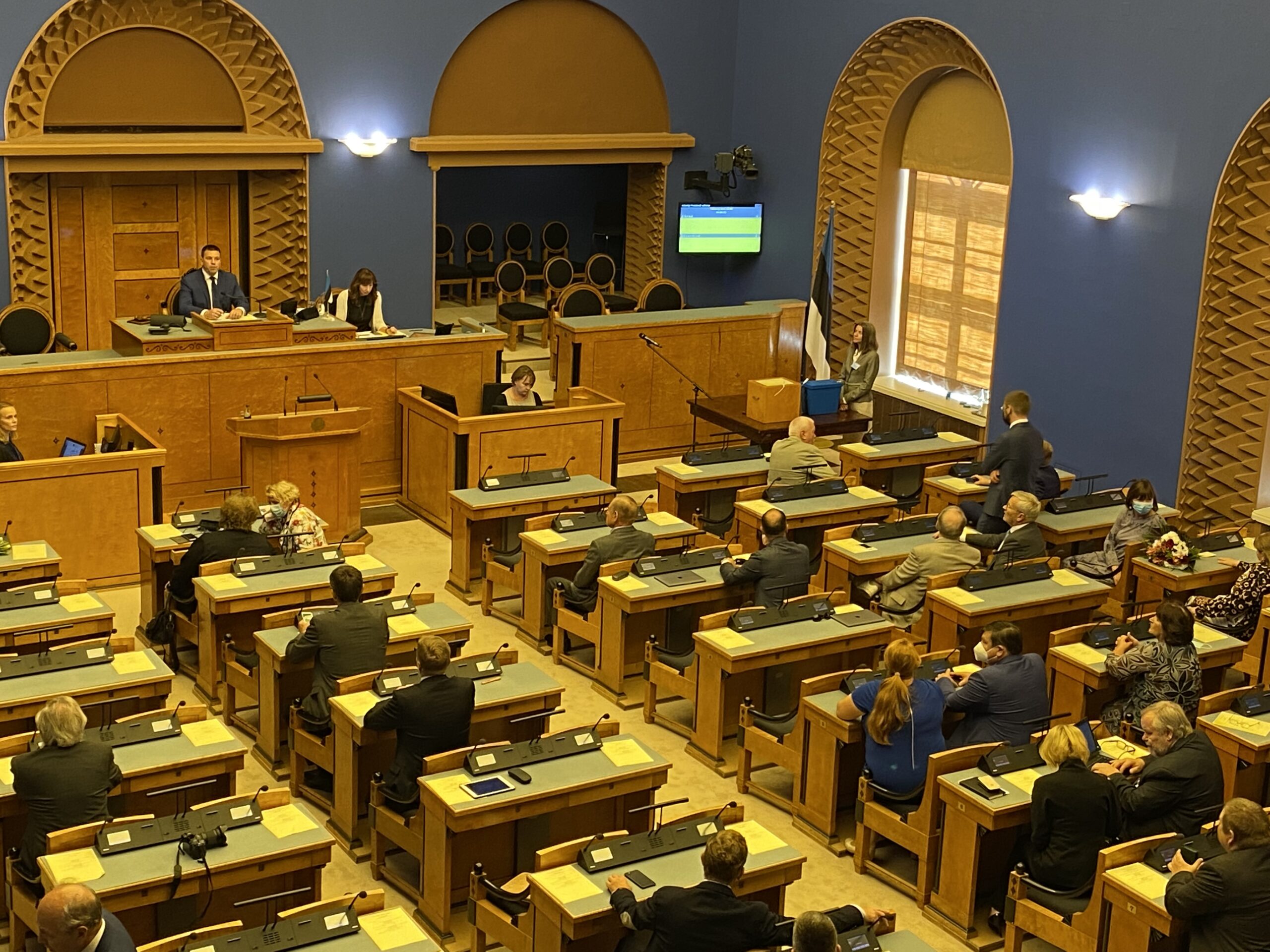
Kiik said the Social Democrats had discussed Madise’s name with several parliamentary groups and unaffiliated MPs. According to him, none of the parties approached had ruled her out.
The exception, he said, was EKRE, the Conservative People’s Party of Estonia, which has maintained its support for Mart Helme, the party’s former leader and former interior minister.
A constitutional authority
Kiik added that the Social Democrats had also spoken to Madise herself and believed other parties had done the same. He said the party hoped she would give the proposal serious consideration.
“We hope she will consider this proposal seriously and respond positively. But this is, of course, a weighty decision and it does not have to be made today,” Kiik said.
He described Madise as someone who could defend the spirit of the constitution, protect rights and freedoms, and help maintain social cohesion at a difficult time.
“She would be a dignified president,” Kiik said.

Madise, 51, has served as Estonia’s chancellor of justice since 2015. In that role, she acts as an independent constitutional watchdog, reviewing legislation and public authority for compliance with the constitution and protecting fundamental rights.
Her profile gives her an unusual position in Estonian public life. She is not a party politician, but she is far from unknown. A lawyer, constitutional scholar and professor of constitutional law at the University of Tartu, Madise has long been one of Estonia’s most visible interpreters of law, rights and state power.
The foreign policy question
Her possible candidacy also comes with an obvious question. The Estonian presidency is a largely ceremonial office, but it carries particular weight in foreign and security policy, especially for a small state on Russia’s border.
Madise’s critics are likely to point out that, unlike some other possible contenders, she does not have a long record in diplomacy, defence or international affairs. Her strength is constitutional authority; her weakness, at least on paper, is limited foreign policy experience.

Born in Tartu in 1974, she graduated from the University of Tartu’s faculty of law in 1998, later completing a master’s degree in law and a doctorate in public administration at Tallinn University of Technology. Her doctoral work examined elections, political parties and legislative performance in Estonia from the restoration of independence to the rise of e-democracy.
Before becoming chancellor of justice, Madise worked in the justice ministry, the parliament’s constitutional committee, the National Audit Office and the Office of the President, where she served as legal adviser from 2009 to 2015. She has also served on the National Electoral Committee and taught at both Tallinn University of Technology and the University of Tartu.
Madise has been closely associated with the Estonian constitution. She has served as editor-in-chief of the annotated editions of the constitution and has frequently appeared in public debate as a legal commentator, particularly on constitutional questions, rights, elections and the limits of state power.

She is also known for her defence of clear Estonian and for her role in debates over language policy. In recent years, she has spoken publicly about the legal status of the Estonian standard language and the role of the ÕS, the Estonian orthological dictionary, in public administration and education.
In 2025, the Estonian chancellor of justice institution received the highest A-status accreditation from the United Nations as a national human rights institution, recognition that allows it to participate in UN human rights forums.
A presidency shaped by Estonia’s security moment
Madise’s possible candidacy would fit a familiar pattern in Estonian presidential elections. The office is not won by popular vote, and candidates rarely succeed on party strength alone. The winner usually needs to be acceptable to a wide range of political forces.
That makes Madise a potentially strong candidate. She has constitutional authority, public visibility and a reputation for independence. At a time when Estonia faces security pressure, political fragmentation and social strain, her supporters are likely to present her as a figure of steadiness rather than spectacle.

The question is whether that will be enough. Estonia’s president is expected not only to embody the constitution at home, but also to explain the country abroad, reassure allies and speak with fluency on Ukraine, Russia, NATO and European security. Madise would enter that field with intellectual authority, but without the diplomatic résumé usually associated with such a role.
For now, Madise has not said whether she is willing to run. That silence may suit the moment. In Estonia, presidents are rarely launched with fanfare; they are assembled through arithmetic, discretion and a search for someone whom enough parties can live with.